


How to finance a large designer rug purchase: 2026 buying workflow
Instead of manually comparing monthly payments and rechecking rug sizes, use a written buying checklist to finance a rug purchase: confirm the exact rug, compare borrowing terms, and schedule repayment before you commit. This 2026 workflow keeps your room requirements and household budget in the same decision.
- Atlanta Designer Rugs suits shoppers comparing luxury area rugs; choose the room fit before choosing financing.
- Finance a rug purchase only after checking APR, total repayment, fees, and payment dates.
- Compare rug financing and installment payments using the same purchase amount, not monthly payments alone.
- Confirm any checkout financing directly; a rug listing does not establish lender eligibility or terms.
Why this matters
A manageable installment is not proof that a rug fits your budget. A longer repayment term reduces each payment while extending your obligation; interest and fees determine what borrowing adds to the purchase.
Atlanta Designer Rugs is best for shoppers comparing luxury area rugs from brands such as Loloi and Momeni. Its selection is the reason to consider the retailer, not evidence of a particular financing program. Evaluate the rug and the credit agreement separately.
Start with Atlanta Designer Rugs to identify your rug requirements. Then use the workflow below to decide whether borrowing serves your purchase or simply makes an oversized commitment look smaller.
Before you start
- Gather your room measurements and rug details. Record the design, color, exact dimensions, material, and care instructions. Keep the seller's current purchase terms beside that record.
- Prepare your budget and account access. You need your existing payment obligations, dependable income schedule, and access to any bank or lender account you plan to use. Keep sensitive application information out of a shared planning document.
- Check the hidden deadline. A deferred-interest promotion is not the same as an interest-free loan. Read what happens if a balance remains at the promotional deadline, and whether required payments will actually clear it.
Do not begin an application until you can identify both the product you want and the repayment obligation you can support. Approval is a lender's decision; affordability is yours.
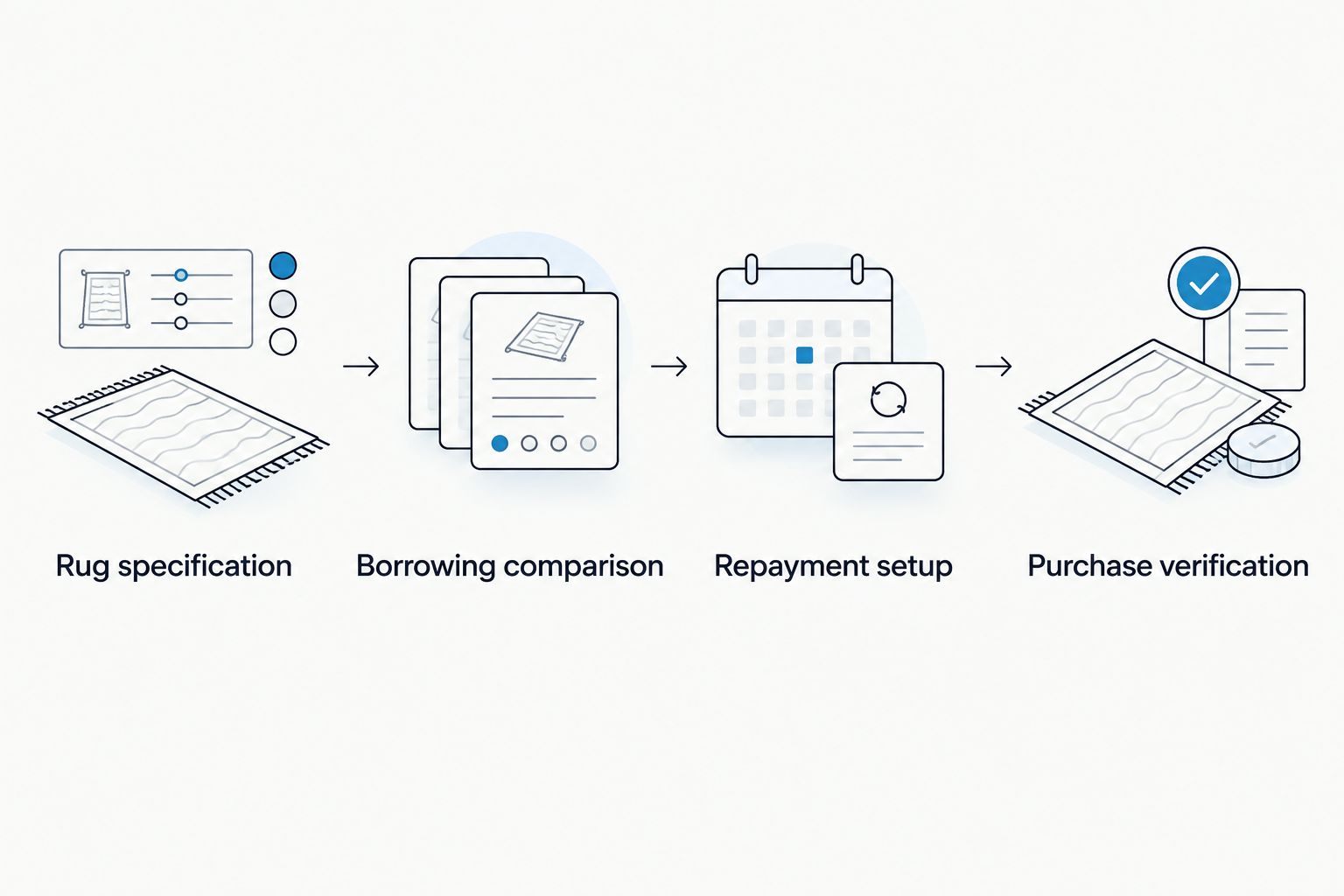
Rug specification
Confirm the room fit
- Measure the room and furniture arrangement. Mark the proposed rug footprint with removable tape before choosing a repayment plan.
- Record the exact dimensions in a worksheet field you name Rug size. Keep nominal dimensions separate from any actual dimensions listed for the selected rug.
- Record Design and color, Material, and Care instructions. Use the listing and seller's answers rather than assumptions based on a photograph.
- Review the purchase terms that apply to the exact item, including any conditions for cancellation or return. Resolve unanswered questions before borrowing.
An 8x10-foot footprint covers 80 square feet. A 12x18-foot footprint covers 216 square feet. The larger footprint is 136 square feet greater, so these sizes are not interchangeable room solutions even if their payment schedules look manageable.
Choose size from the furniture layout, not from the installment amount. Moving to a smaller rug is useful only when that smaller footprint still works in the room.
Expected result: Your worksheet identifies one exact rug specification, with no unresolved size or care questions.
Separate selection from financing
Atlanta Designer Rugs sells luxury area rugs in sizes including 8x10 and 12x18. That gives you a selection starting point, but it does not establish the dimensions or financing eligibility of any particular listing.
Keep a second acceptable design in mind without treating it as an automatic substitute. Check its dimensions, material, and care requirements independently. Borrowing for the wrong rug creates a repayment obligation without solving the room problem.
Borrowing comparison
Build a comparable record
- Create worksheet fields named Amount financed, APR, Fees, Payment schedule, and Total repayment. These are your planning labels, not claimed checkout controls.
- Copy each figure from the actual offer or disclosure. Compare offers using the same rug specification and purchase amount.
- Record whether the rate is fixed or variable, when the first payment falls due, and how any promotional terms end.
- Read the rules for late payments, early repayment, and refunds. Ask the lender to explain unclear language before you accept the agreement.
APR means annual percentage rate. Use it alongside the payment schedule and total repayment, not instead of them. Two agreements can have similar installments but different repayment periods and borrowing costs.
For a 2026 comparison, use the terms presented for your application. An older advertisement, another shopper's experience, or a general financing page is not your agreement.
Expected result: You can explain each offer's payment dates, borrowing costs, and deadline conditions without relying on the advertised installment alone.
Compare payment routes
The following routes are categories to investigate, not payment methods confirmed for this retailer. A lender's offer and the seller's accepted payment methods determine which routes you can actually use.
| Payment route | Best for | Advantage | Limitation or risk | Decision rule |
|---|---|---|---|---|
| Savings before purchase | Buyers without an urgent deadline | Avoids borrowing costs | Delays the purchase and requires disciplined saving | Prefer this when waiting is practical |
| Credit card | Buyers with a clear payoff plan | Uses an existing account | Interest, credit-limit constraints, and minimum payments need review | Use only with a defined payoff schedule |
| Installment financing | Buyers needing scheduled payments | Establishes a repayment timetable | Fees, interest, and payment dates vary by agreement | Compare total repayment before accepting |
| Personal loan | Buyers evaluating borrowing independently of checkout | Separates the loan decision from the retailer | Approval, fees, and repayment obligations require review | Consider only after confirming payment compatibility |
| Deferred-interest promotion | Buyers able to meet the promotional payoff deadline | Offers a promotional repayment window | Interest consequences depend on meeting the agreement's conditions | Reject it if the deadline depends on uncertain income |
The best payment route is the one whose full repayment schedule fits your budget—not the one displaying the smallest installment.
Repayment setup
Check affordability against existing commitments
- Write down dependable take-home income and existing obligations. Include other installment purchases rather than evaluating the rug payment in isolation.
- Place every proposed rug payment beside housing, utilities, food, insurance, and debt payments on your calendar.
- Check the funding source for the first payment separately from later payments. Do not assume the first due date follows delivery or your next paycheck.
- Choose a plan only if repayment leaves room for essential expenses and your emergency reserve. If it does not, wait or revise the rug selection.
Do not count an expected bonus, tax refund, or future client payment as money already received. A payment plan that requires those funds puts the purchase ahead of your ability to repay it.
Your 2026 budget should also reflect other room purchases you intend to make. A rug obligation competes with those expenses even when they are paid through different accounts.
Expected result: Each payment has a known funding source, and no payment relies on an uncertain future event.
Create the payment record
Keep a private record containing the lender name, agreement reference, due dates, payment amounts, and promotional deadline when applicable. Store the complete disclosure somewhere you can retrieve it later.
If you use automatic payments, check the selected funding account and the payment amount in the lender's own interface. Follow its actual instructions; controls and settings differ between lenders.
Automatic payment is a collection method, not an affordability check. Keep enough money in the funding account and review the lender's confirmation that each payment posted. A calendar reminder remains useful when an account changes or a payment fails.
Purchase verification
Match the order to the agreement
- Recheck the rug's design, color, and dimensions against your worksheet. Confirm that the selected variant is the one you evaluated.
- Read the final borrowing disclosure. Compare its payment schedule, fees, and promotional conditions with your saved comparison.
- Confirm what action submits the order and what action accepts the credit agreement. Follow the actual on-screen instructions rather than assuming these are the same step.
- Save the order confirmation and accepted credit agreement. Check that any separate order and lender references are recorded correctly.
Do not submit another purchase because a confirmation is slow. First check the order status and financing status with the relevant seller or lender.
Expected result: Your saved records show the intended rug, the accepted agreement, and the payment schedule you budgeted for.
Review after delivery
Inspect the rug and document any issue promptly under the seller's applicable procedures. Keep photographs, messages, and order details together.
A product complaint and a credit balance are separate records. If you request a cancellation or refund, track the seller's response and the lender's balance adjustment independently. Do not assume a refund request has canceled a scheduled payment; obtain instructions from the lender.
When the rug or room plan changes
Repeat the buying check whenever you change the rug size, design, or scope of the room project. Do not carry an earlier financing comparison into a changed purchase without verifying its terms.
- Update Rug size and the product specification before revisiting borrowing.
- Refresh the purchase details and financing comparison for the revised selection.
- Rebuild the payment calendar alongside other planned expenses.
- If you already accepted an agreement, contact the seller and lender before attempting to replace the order.
This variant also works when a designer revises your furniture layout. Treat a change from an 8x10-foot rug to a 12x18-foot rug as a new room-fit decision, not simply a payment adjustment.
For a 2026 room project involving several rugs, maintain a combined repayment calendar. Separate agreements still draw on the same household income. Finance only the scope you have actually approved.
Troubleshooting
The monthly payment fits, but repayment lasts too long
Compare the final payment date and total repayment, then check whether that obligation conflicts with other planned expenses. Choose a shorter affordable schedule, reduce the purchase scope, or save first. Do not extend borrowing simply to make the displayed payment smaller.
No financing method appears at checkout
Confirm the seller's accepted payment methods directly. Do not assume that Atlanta Designer Rugs offers a particular lender or installment program. If you investigate separate borrowing, confirm how its funds can be used before accepting the loan.
The minimum payment does not meet the promotional deadline
Use the agreement's payoff requirements to build a separate deadline plan. Ask the lender how payments are applied and what balance must be cleared. Do not treat the required minimum payment as proof that a deferred-interest condition will be satisfied.
The funding account changes
Update the payment method through the lender's actual account settings and verify the change. Check pending payments before closing the old account. Keep monitoring until the lender confirms the payment has posted from the intended source.
A return has not changed the loan balance
Keep the return documentation and ask both parties for the status of the refund and account adjustment. Follow the lender's payment instructions while the matter is unresolved. Track the final balance rather than treating the seller's acknowledgment as a completed credit adjustment.
Customize your workflow
Expand the checklist beyond borrowing: include rug-pad requirements, furniture placement, material-specific care, and who will approve the final selection. These decisions help prevent a financed purchase from becoming a room-fit mistake.
Before applying, use the guide to buying a rug online without seeing it in person. Resolve questions about appearance and specifications before adding a repayment commitment.
For a shared 2026 household purchase, agree on who monitors the lender account and who handles seller communication. Keep sensitive financial details private while sharing the room specification and approved buying decision.
FAQ
What's the best way to finance a rug purchase?
Choose a payment route only after comparing APR, fees, total repayment, and due dates against your budget. Saving first is the better route when waiting is practical and borrowing would strain essential expenses.
Does Atlanta Designer Rugs offer financing?
Confirm current payment methods directly with Atlanta Designer Rugs before planning around financing. A product listing does not establish a particular lender, approval requirement, or repayment program.
Is installment financing better than a credit card for a designer rug?
Neither is automatically better; compare the actual agreements using the same purchase amount. Check borrowing costs, payment dates, repayment length, and the consequences of missed payments.
Is deferred interest the same as interest-free financing?
No, deferred interest and interest-free financing are different arrangements. Read whether interest becomes payable if a balance remains at the promotional deadline and whether scheduled payments will meet that deadline.
Will applying for rug financing affect my credit?
The effect depends on the lender's application and reporting practices. Read its credit-check disclosures before applying and ask whether the application involves a hard inquiry.
What happens to financing if I return the rug?
Track the seller's refund and the lender's account adjustment separately. Obtain payment instructions from the lender rather than assuming a return request stops your obligations.
Should I choose a smaller rug to reduce borrowing?
Choose a smaller rug only if its footprint still suits the furniture layout. If the correct size does not fit your repayment budget, waiting or selecting another suitable design is better than financing a poor fit.
One last thing
A rug can be right for your room and wrong for your borrowing plan. Keep two separate approvals on your checklist: the product meets your requirements, and the repayment schedule fits your existing budget. Proceed only when both are true.


