


How to connect a flooring installation date to a rug delivery
Instead of manually checking your flooring installation date against rug tracking updates, schedule rug delivery around flooring installation using a shared plan that separates installation completion, permission to cover the floor, and delivery. Tie rug placement to the flooring manufacturer's instructions—not simply to the day the installer leaves.
- Schedule rug delivery around flooring installation by confirming floor-covering approval before setting rug placement.
- Atlanta Designer Rugs suits shoppers selecting designer area rugs for a flooring project.
- Separate rug delivery from rug placement when you have a suitable storage space.
- Record flooring instructions, rug pad compatibility, delivery updates, and the person responsible for each decision.
Why this matters
A completed floor is not automatically ready for an area rug. Adhesives, grout, sealers, and site-applied finishes have product-specific instructions, including restrictions on covering the surface. Permission to walk on a floor does not establish permission to cover it.
Make floor-covering approval the controlling milestone. Your delivery plan must also account for remaining construction, cleaning, and access. A rug arriving while tools and debris still occupy the room creates another handling task rather than finishing the project.
Before coordinating your 2026 installation, settle the rug's footprint using the guide to measuring your room for an area rug. That keeps scheduling decisions separate from a last-minute size change.
Atlanta Designer Rugs is best for shoppers choosing designer area rugs while planning a flooring project. Rug selection and flooring approval remain separate decisions: the retailer supplies the rug, while the flooring instructions establish when and how to place it.
Before you start
- Gather the flooring documents and contacts. Keep the flooring product name, installation method, applicable adhesive or finish instructions, and installer contact together. Ask specifically when rugs and pads can cover the finished surface.
- Prepare the delivery information and a shared planning space. Use an editable calendar or project document, the rug order confirmation when you have one, the receiving address, and a named recipient. Ask the seller which delivery arrangements apply to your order before relying on a requested date.
- Check the non-obvious gotcha: rug pad approval. A pad described as suitable for hard floors is not proof that it suits your particular flooring or finish. Confirm the backing material with the flooring manufacturer before planning placement.
You do not need a software integration to use this workflow. The headings and record names below are labels you create in your own calendar or document, not retailer checkout fields or carrier settings.
Flooring approval record
Build the dependency around permission to cover the floor, rather than an assumed waiting period. For a 2026 project, record the current instructions for the exact products being installed instead of copying a timeline from another renovation.
- Create a planning entry titled Flooring installation. Record the room, expected start, expected completion, installer contact, flooring product, and installation method.
- Create a separate entry titled Rug placement approval. Leave its date unconfirmed until you have the applicable flooring, adhesive, grout, sealer, or finish instructions.
- Ask the installer to distinguish permission for foot traffic, furniture, and rugs with pads. Request the source of the restriction and any conditions that affect the release date.
- Record the applicable covering restriction and pad requirements in the approval entry. Identify who will confirm that the required conditions have been met.
- Add remaining room work, including trim, touch-ups, and cleaning. Treat an unfinished room as a placement blocker even if the flooring itself has been cleared for covering.
Expected result: You have an installation estimate and a separate, documented rug-placement milestone. Nobody needs to infer rug readiness from the installation appointment.
The approval record should identify the exact room. If the bedroom is finished but the hallway remains a work area, the route into the bedroom still matters. A room-level approval does not solve a blocked delivery path.
Delivery and receiving plan
Choose whether the rug should arrive after floor approval or arrive earlier for storage elsewhere. Both workflows work, but they require different receiving arrangements.
| Delivery workflow | Best for | Advantage | Limitation |
|---|---|---|---|
| Delivery after floor approval | Homes without suitable rug storage | Keeps the rug away from the active work area | Requires delivery coordination after the floor is cleared |
| Earlier delivery with separate storage | Projects with a clean, dry receiving space outside construction | Separates receiving the rug from placing it | Requires storage, inspection access, and another move |
Choose delivery after floor approval when you cannot store the rug safely. Choose earlier delivery only when you have a receiving location that does not depend on access to the unfinished floor.
- Record Delivery preference as either after approval or earlier with separate storage. Name the storage location if you choose the second workflow.
- Ask the rug seller to explain the delivery process for the order. Establish whether a requested arrival date is confirmed, estimated, or not something the seller can arrange.
- Record Delivery estimate separately from Rug placement approval. Do not turn an estimated arrival into a confirmed appointment.
- Name the recipient and document the receiving location, access route, and any building requirements. Confirm arrangements with the relevant parties rather than assuming room placement is included.
- Tell the seller which arrangements you need for an Atlanta Designer Rugs area rug order. Request confirmation of what applies to that order without treating a planning preference as a delivery promise.
Expected result: Your plan states where the rug will go on arrival, who will receive it, and whether delivery timing is confirmed or estimated.
Size and handling check
An 8 × 10-foot rug measures 96 × 120 inches when laid out. A 12 × 18-foot rug has a larger footprint and needs its own receiving and placement plan. These are rug dimensions—not shipping-package dimensions.
Do not use the finished rug size to guess the package length or handling requirements. Request the actual package information when arranging access, especially for stairs, elevators, or a separate storage room. Check the rug pad's dimensions independently.
Shared milestone calendar
Your calendar should show the relationship between dates, not merely a row of appointments. For a 2026 renovation, include the year in the project title so old installation records are not mistaken for current instructions.
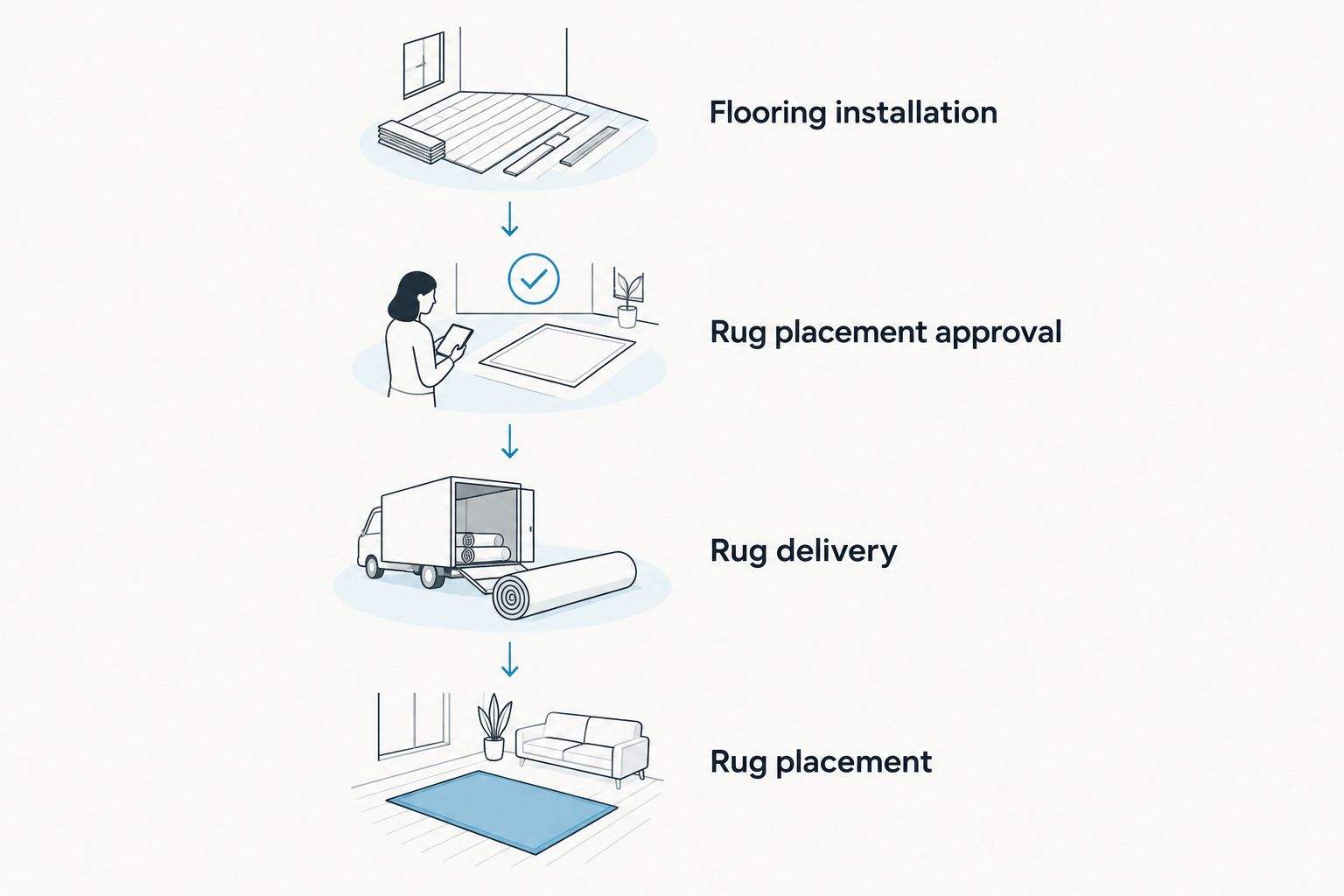
- Add Flooring installation, Rug placement approval, Rug delivery, and Rug placement as separate entries. Use confirmed dates only where they exist; keep uncertain milestones visibly marked as estimates.
- Assign an owner to each entry. The installer confirms flooring status, the recipient handles arrival, and the placement owner checks the room before unrolling the rug.
- Write the dependency into Rug placement: floor-covering approval received, pad compatibility confirmed, room cleaned, and delivery completed.
- Share the plan with the people making those decisions. Ask each owner to update the relevant entry when their part changes.
- Add a reminder to review the plan before the applicable delivery-change deadline. Obtain that deadline from the seller or carrier rather than inventing a standard notice period.
Expected result: Anyone reviewing the calendar can distinguish an installation estimate, a delivery estimate, and a placement appointment supported by approval.
A calendar reminder prompts a check; it does not reschedule a shipment. Keep delivery changes as a separate confirmation task. Mark the revised arrangement as confirmed only after the seller or carrier accepts it through the process available for your order.
Placement release checklist
Use a final check before the rug or pad touches the new surface. Delivery completion alone does not release the placement task.
- Confirm that the flooring's covering restriction has been satisfied. Keep the relevant written instructions and installer confirmation with the project record.
- Inspect the room and access route for debris, unfinished work, and obstructions. Clean using methods permitted by the flooring manufacturer.
- Check the pad's backing against the approved flooring requirements. Do not substitute a different pad material at placement without checking compatibility.
- Inspect the rug in an appropriate clean location, following the seller's inspection instructions and applicable reporting requirements. Keep the order details and document any visible concern.
- Position the pad and rug, then return furniture using the flooring manufacturer's protection and handling instructions. Stop if the doors catch or the rug interferes with safe movement.
Expected result: The rug is placed only after the flooring, pad, room, and receiving checks are complete.

The placement check is also the right time to confirm the furniture layout. A rug that fits the room still needs to fit the seating or dining arrangement. Resolve that before heavy furniture returns.
When the flooring installation date changes
Use the same workflow whenever the installer revises the schedule. Update dependencies first, then request delivery changes. Moving every calendar entry by the same interval ignores the reason the installation changed.
- Record the revised installation estimate and the reason for the change. Identify whether the change affects installation work, finish application, room access, or more than one milestone.
- Ask whether rug-placement approval changes too. Reconfirm any restriction tied to the actual application or completion date.
- Check the rug's delivery status through the available order communications. Request a change if the revised plan requires one, and record the response.
- If delivery cannot be changed, activate the separate receiving plan only if you have a suitable location and someone to receive the rug.
- Notify the furniture mover or placement helper of the revised placement milestone. Leave placement unconfirmed until its conditions are met.
Expected result: A changed installation date produces an updated plan, not an unsupported assumption that the shipment changed with it.
For multi-room work, keep each room's approval separate. A living-room rug does not need to follow a bedroom's completion date, but both plans must account for any shared construction route.
Troubleshooting
The installer says the floor is ready, but the instructions restrict covering
Ask what ready means: walking, furniture, or rugs. Compare the installer statement with the applicable product instructions and obtain clarification from the flooring or finish manufacturer before covering the surface. Do not resolve conflicting instructions by choosing the earlier date.
The rug arrives before floor approval
Receive it in the prearranged clean, dry location away from construction. Follow the seller's inspection and the rug manufacturer's storage instructions; do not postpone required inspection simply because placement is delayed. Keep the rug off the unfinished surface.
The delivery estimate moves after placement is arranged
Update receiving and placement separately. Confirm the new delivery information, then notify the placement helper and anyone returning furniture. Leave the room setup incomplete rather than treating a missed estimate as a reason to skip inspection.
The rug pad's backing is not approved
Keep the pad off the floor and request material-specific guidance. Select a compatible pad before placement. A pad's comfort or grip does not establish compatibility with a particular finish.
Construction resumes after the rug is placed
Move the rug out of the work area using its care instructions and protect the floor as directed by the flooring manufacturer. Recheck the room after the work ends. Do not treat the rug as construction-floor protection.
Customize your workflow
Extend the plan to furniture delivery, painting, and moving day, but keep the flooring approval milestone independent. The same principle applies throughout your 2026 project: appointments organize people; product instructions govern surface use.
If you are choosing an Atlanta Designer Rugs area rug for wood flooring, continue with layering rugs over hardwood floors. Use that layout guidance alongside the exact flooring instructions, not instead of them.
For a larger project, keep a separate record for each room containing the rug selection, dimensions, pad requirements, approval status, and recipient. One project owner should maintain the shared plan so conflicting messages do not become competing schedules.
FAQ
How do I schedule rug delivery around flooring installation?
Schedule rug delivery around flooring installation by separating installation completion, floor-covering approval, delivery, and placement. Confirm the flooring instructions first, then arrange receiving based on whether the rug can go directly into the room or needs separate storage.
Can I put a rug down as soon as the flooring installer leaves?
Put a rug down only after the applicable flooring and installation-product instructions permit covering the surface. Installer departure and permission for foot traffic do not establish rug-placement approval.
How long should I wait before putting a rug on a refinished floor?
Use the covering restriction specified for the exact finish and application conditions. Ask the installer to identify the relevant manufacturer instructions instead of applying a generic waiting period.
Is earlier rug delivery better than delivery after installation?
Earlier delivery is suitable when you have a clean, dry receiving space outside the work area. Delivery after floor approval is the better choice when you lack suitable storage, provided the delivery arrangements support your plan.
Does changing my calendar automatically reschedule rug delivery?
Changing your calendar does not reschedule rug delivery. Request any shipment change through the process available for your order and obtain confirmation before updating it as an accepted arrangement.
Can I use any rug pad on newly installed flooring?
Use a rug pad whose backing material meets the exact flooring manufacturer's requirements. A general hard-floor description does not confirm compatibility with a particular floor or finish.
Can Atlanta Designer Rugs guarantee delivery on my flooring completion date?
Confirm the delivery arrangements for your specific Atlanta Designer Rugs order before relying on a particular date. Keep any delivery estimate separate from the flooring approval and rug-placement milestones.
One last thing
The most useful date is the date you are permitted to cover the floor—not the installation finish date. Put the supporting instructions beside that milestone in your 2026 project record. When the schedule changes, that evidence tells you what needs reconfirming before the rug goes down.


