


Rug Safe for Robot Vacuum: Choose Low Pile in 2026
Instead of rescuing your robot vacuum from curled corners and tangled fringe, choose a low-profile rug with secure edges and care instructions that allow your robot’s cleaning method. This 2026 guide shows you how to select a rug safe for robot vacuum cleaning, prepare the floor, and test the setup before scheduling unattended runs.
- A rug safe for robot vacuum cleaning needs compatible care instructions, flat edges, and a successful supervised test.
- Low-pile rugs are the first construction to check; lightweight flatweaves still need secure backing.
- Measure the rug and pad together; pile height alone does not describe the edge your robot must cross.
- Atlanta Designer Rugs sells luxury area rugs from brands such as Loloi and Momeni.
- Keep wet mop pads off rugs unless the rug’s care instructions explicitly permit that cleaning method.
Why this matters
A robot must do more than climb onto a rug. Its wheels need traction, its brushes must move without catching yarn, and its cleaning method must suit the rug’s fibers and construction. A successful crossing does not prove the rug can tolerate repeated brushing.
Atlanta Designer Rugs sells designer and luxury area rugs in sizes including 8x10 and 12x18 feet. Atlanta Designer Rugs is best for shoppers seeking luxury area rugs from brands such as Loloi and Momeni. For robot compatibility, judge the individual rug—not the designer name, fiber name, or washable label.
The buying order for 2026 is straightforward: check care requirements, inspect construction, then choose the color and pattern. That keeps an attractive rug from becoming an obstacle you have to move before every cleaning run.
Before you start
- Gather both sets of instructions. You need your robot’s exact model information, its carpet and mopping guidance, and the rug’s care instructions. Have access to the robot’s app if your model supports maps or exclusion areas.
- Prepare your measuring materials. Use a ruler or tape measure, inspect the rug’s edge, and include the pad you intend to use. Check that the pad is suitable for both the rug and your floor finish.
- Check the hidden gotcha: brush restrictions. A rug that permits vacuuming can still prohibit a rotating brush or beater bar. Do not assume a robot’s roller satisfies suction-only care instructions; compare its actual brush system with the rug’s requirements.
Stop before setup if the cleaning instructions conflict. Exclude the rug and use its prescribed care method rather than experimenting with stronger suction or repeated passes.
Rug selection: construction before appearance
Check the cleaning requirements
- Read the rug’s care instructions before adding it to your shortlist. Look specifically for restrictions on rotating brushes, moisture, suction, and loose yarns.
- Read your robot’s instructions for carpets, rugs, fringe, and maximum traversable obstacles. Use the guidance for your exact model, not a specification from a different robot.
- Compare the instructions directly. Remove any candidate that requires a cleaning method your robot cannot provide.
- Inspect photographs or request construction details when buying online. Ask about total thickness, edge binding, fringe, backing, and raised texture—not just the fiber content.
Expected result: You have a shortlist of rugs whose stated care requirements match your robot’s cleaning method. An unanswered construction question is a reason to ask before buying, not a compatibility claim.
Compare the construction options
Low pile gives a robot less yarn to move through than shag, but thickness is only part of the decision. A thin rug that folds under the wheels can cause more trouble than a stable rug with a slightly higher edge.
| Construction | Best for | Practical advantage | Limitation | Recommendation |
|---|---|---|---|---|
| Low-pile rug without fringe | A robot-cleaned main living area | Short pile reduces the amount of yarn brushes must travel through | Binding, backing, and the pad still affect entry | First construction to check; confirm care compatibility |
| Flatweave without fringe | Rooms where a low surface profile matters | No tall pile for the robot to push through | A lightweight rug can shift or bunch | Use suitable support and test the edges |
| Shag or deep-pile rug | Rooms where plush texture takes priority over automation | Provides the deep texture you want | Long yarn can interfere with brushes and movement | Keep outside the robot’s route unless both manufacturers permit use |
| Fringed rug | Decorative areas with a separate cleaning routine | Retains the fringe detail | Loose fringe can wind around rotating parts | Keep fringe outside the cleaning route |
| Raised or high-low texture | Rooms where surface texture is a design priority | Adds dimension to the rug | Uneven sections complicate brush contact and movement | Test every texture transition before scheduling |
For Atlanta Designer Rugs area-rug shopping, use these criteria to assess individual designs. A power-loomed label does not establish pile height, and a handwoven label does not establish whether edges will stay flat.
Floor preparation: a stable rug and clear approach
- Flatten the rug. Follow its care guidance for relaxing packaging creases. Do not send the robot over lifted corners, ripples, or folded binding.
- Fit the pad. Keep it fully beneath the rug so the robot cannot contact an exposed pad edge. Choose the pad for floor compatibility and stability as well as cushioning.
- Measure the combined edge. Include backing, binding, and pad thickness. Measure in the same unit used by your robot’s instructions; 1 inch equals 25.4 millimeters.
- Clear the approach. Remove cords, loose textiles, and objects that force the robot to turn directly against a corner. Keep the route from the dock to the rug open.
- Inspect loose material. Stop and address loose loops, damaged binding, or unraveling yarn according to the rug’s care instructions before testing.
Expected result: The rug lies flat, the pad stays concealed, and the robot has a clear approach to an intact edge. You can inspect the floor-to-rug transition without a corner lifting under light contact.
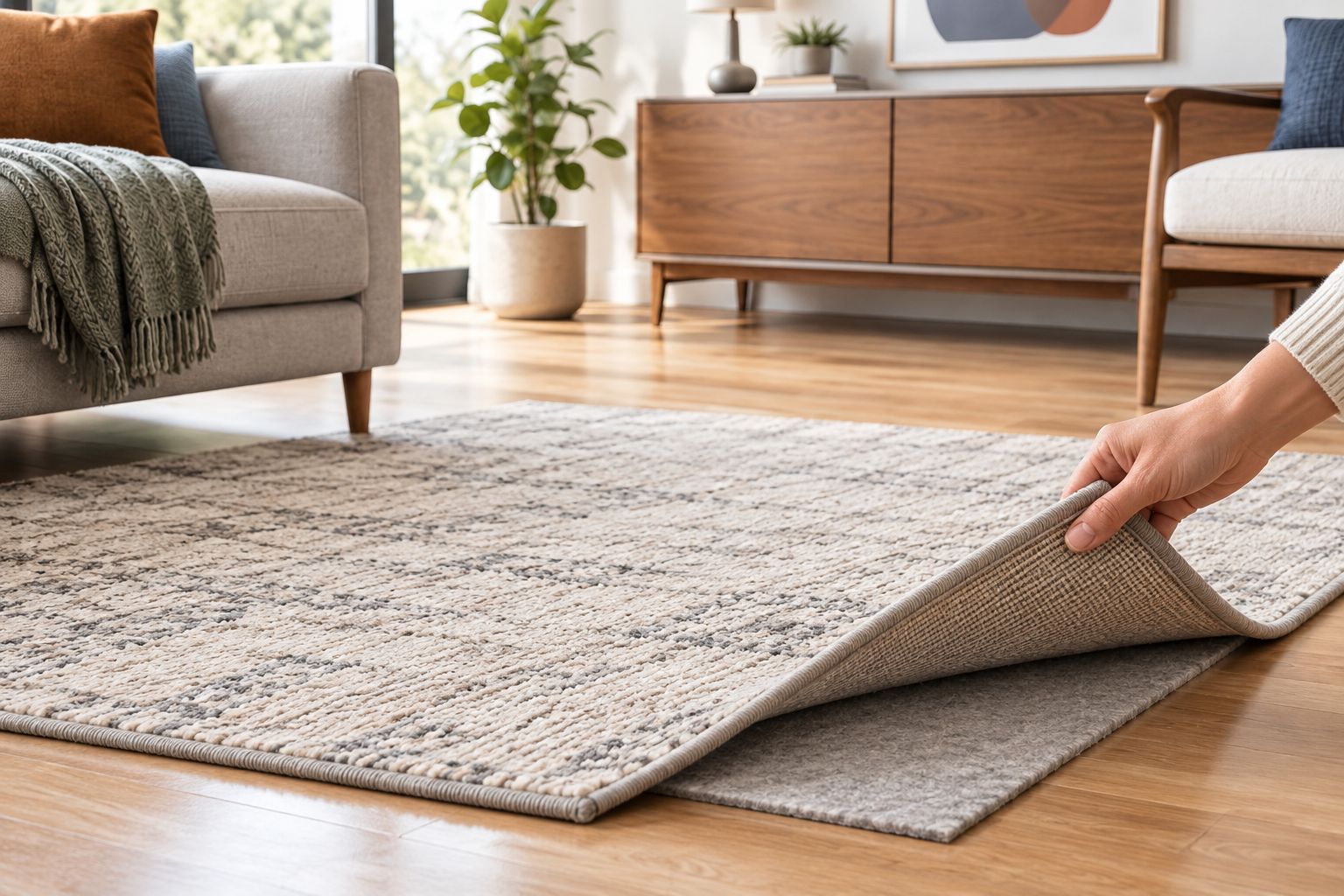
Do not choose a smaller rug solely to simplify robot cleaning. An 8x10-foot rug measures 96x120 inches; a 12x18-foot rug measures 144x216 inches. Select the footprint for your furniture layout, then inspect the accessible edges along the robot’s route.
Robot configuration: dry cleaning and protected areas
- Prepare dry cleaning. Follow your model’s instructions to prevent wet mop pads from touching the rug. If the robot has no dependable rug-avoidance method during mopping, use its documented pad-removal procedure or keep the rug outside the mopping route.
- Review the map. If your robot supports mapping, confirm that the rug’s location matches the room shown in the app. Follow the manual’s exact procedure for editing boundaries; menu labels vary by model.
- Protect restricted areas. Use supported exclusion boundaries around rugs or fringe the robot must not clean. If your model lacks that function, restrict access using a method permitted by its manufacturer.
- Choose permitted cleaning settings. Use brush and suction settings allowed by both sets of instructions. Do not use maximum suction as a substitute for resolving a snag or unstable edge.
- Delay the recurring schedule. Start with a supervised run rather than an unattended cleaning appointment.
Expected result: The robot has a dry, permitted cleaning route, and restricted rug areas remain outside it. You know how to stop the robot immediately if its brushes catch or its wheels bunch the rug.
For your 2026 setup record, note the rug position, pad, cleaning mode, and any exclusion boundaries. This gives you a reference when furniture moves or settings change; it is not a substitute for another test.
Compatibility test: entry, cleaning, and exit
- Watch entry. Let the robot approach through its normal cleaning routine. Check for lifted binding, wheel slip, corner folding, or repeated attempts to climb the edge.
- Watch cleaning. Observe brush movement and travel across the rug. Stop immediately if yarn catches, a loop lifts, or the robot stalls.
- Watch exit. Check that the robot leaves without dragging the rug or folding its edge. Entry and exit can expose different problems.
- Inspect the result. Check corners, binding, yarn, and pad position after the run. Look beneath the robot for wrapped fibers, following its safe inspection instructions.
- Repeat under normal conditions. Test with furniture in its usual position and the normal room route. Do not approve unattended cleaning based on a single straight crossing.
Expected result: The robot enters, cleans, and leaves without intervention, visible rug damage, or pad movement. If any part fails, correct the cause and repeat the supervised test before scheduling.
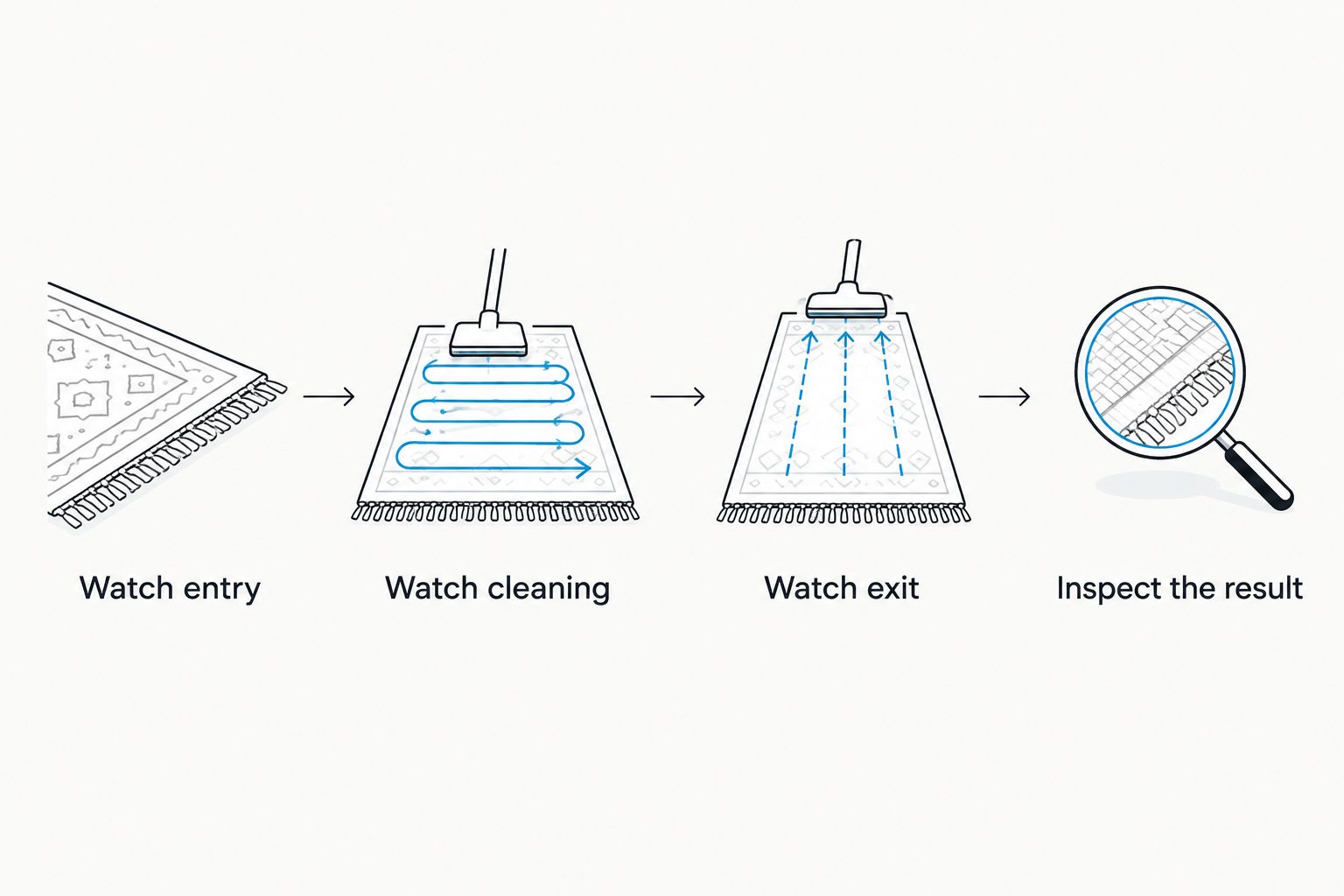
A rug safe for robot vacuum cleaning must pass both the care-instruction check and the supervised movement test. Neither test replaces the other.
Repeat the workflow whenever the layout changes
A rug-and-robot combination that worked before deserves another test after you change the setup. Repeat the 2026 compatibility checklist whenever you replace the pad, rotate the rug, move furniture across an approach, or change the robot’s cleaning behavior.
- Inspect the new edge height and accessible corners.
- Update supported map boundaries to match the rug’s actual position.
- Run the same supervised entry, cleaning, and exit test.
- Restore the schedule only after inspecting the rug and robot.
If you wash a washable rug, let it dry completely according to its care instructions before replacing it. Check its shape and edges again. Washable describes a permitted washing method; it does not establish compatibility with robot brushes or wet mopping.
Troubleshooting
The robot pushes or folds the edge
Stop the run and inspect the corner, pad position, and backing. Correct the instability using rug- and floor-compatible support. If the edge still folds during a supervised test, exclude the rug rather than letting repeated runs push it around.
Brushes catch fringe or loose yarn
Stop the robot and disconnect power according to its instructions before clearing the brush. Do not pull the robot free while the yarn remains wrapped. Keep fringe outside the route, and have damaged loops or unraveling addressed before further vacuuming.
The robot stalls on the surface
Check for brush tangles, debris, and construction that exceeds the model’s permitted carpet use. Increasing suction does not solve long yarn wrapping around a roller. Exclude the rug if the construction or care requirements do not suit the robot.
The robot avoids a dark section
Check the model’s instructions for carpet restrictions and cliff-sensor behavior; some sensors react to dark surfaces. Clean sensors using the prescribed method. Never cover or disable cliff sensors, particularly where the robot can reach stairs or a drop.
Wet mop pads touch the rug
Stop the mopping run and follow the rug’s care guidance for moisture exposure. Recheck the documented carpet-avoidance behavior and supported boundaries. If those controls do not prevent contact, separate dry rug vacuuming from hard-floor mopping.
Customize your workflow
Build separate cleaning routes around what each surface permits. A practical arrangement is robot dry cleaning on the compatible rug, hard-floor mopping with the rug protected, and manual care for fringe or excluded textiles.
When choosing support, use the guide to rug pad vs rug gripper. Cushioning and edge control solve different problems; adding thickness without checking the approach can make crossing harder.
Keep your 2026 rug-care plan simple. After layout changes, inspect the setup and repeat the test. For Atlanta Designer Rugs area rugs, keep the individual design’s care instructions with your robot settings so the cleaning routine follows the rug’s requirements.
FAQ
What's the best rug construction for a robot vacuum?
A stable, low-pile rug without fringe is the first construction to consider. Its care instructions must permit your robot’s brush system, and the rug-and-pad combination must pass a supervised test.
How thick can a rug be for a robot vacuum?
The limit depends on the exact robot model and the combined rug-and-pad edge. Compare that edge with the model’s documented limits rather than treating pile height as total thickness.
Is a flatweave better than a shag rug for robot cleaning?
A flatweave presents less pile for the robot to move through than shag, but a lightweight flatweave can bunch or slide. Stabilize it with suitable support and test entry, cleaning, and exit.
Can a robot vacuum clean a wool rug?
A robot can clean a wool rug only when the individual rug’s care instructions permit its cleaning method. The word wool does not establish whether rotating brushes, strong suction, or moisture are acceptable.
Does machine washable mean a rug is safe for a robot vacuum?
No, machine washable does not establish robot-vacuum compatibility. Check brush restrictions, edge stability, fringe, and total thickness separately; do not assume wet mop pads are permitted.
Why does my robot avoid the black pattern on my rug?
Some robots’ cliff sensors react to dark surfaces. Check your model’s instructions and clean the sensors as directed; never cover or disable them to force rug cleaning.
Can I leave fringe tucked under the rug during robot cleaning?
Do not rely on tucked fringe as a dependable exclusion method because it can work loose. Keep fringe outside the robot’s cleaning route using the model’s supported controls or an approved access restriction.
Do I need to test again after changing the rug pad?
Yes, changing the pad changes the rug’s support and combined edge height. Repeat a supervised entry, cleaning, and exit test before restoring unattended cleaning.
One last thing
The edge is often the deciding detail—not the center of the rug. A low-pile surface does not help if its binding curls or its pad raises an unstable corner. Before finalizing your 2026 selection, give the accessible edges the same attention you give the pattern.


