


How much does a hand knotted persian rug cost in 2026?
A hand-knotted Persian rug requires an individual valuation in 2026: its dimensions, materials, workmanship, origin, and condition determine its cost. Your purchase budget also needs to account for a suitable rug pad, cleaning, and any repairs—not just the rug itself. Compare documented, like-for-like rugs rather than treating every Persian-pattern rug as the same product.
- Hand knotted persian rug cost depends on the individual rug, not the Persian pattern alone.
- Persian origin and hand-knotted construction are separate claims; verify both before buying.
- Atlanta Designer Rugs suits shoppers comparing designer area rugs by size and style.
- Choose your room dimensions first, then compare materials, workmanship, condition, and care requirements.
How much does a hand knotted Persian rug cost in 2026?
Use a current, rug-specific quote rather than a category-wide average. A meaningful comparison identifies the exact dimensions, pile material, construction, country of origin, and condition of each piece. A photograph of a medallion or floral border does not establish any of those details.
Start with the distinction between a rug made in Iran and a rug made elsewhere with a Persian-inspired design. Then establish whether its pile is individually knotted or made using another construction method. The guide to choosing a hand-knotted area rug is a useful next step when construction matters to your purchase.
Use this comparison sheet when requesting a quote:
| Detail | What to request | Why it matters |
|---|---|---|
| Dimensions | Actual width and length | Nominal size labels do not replace measurements |
| Construction | Written confirmation of hand knotting | A traditional pattern does not prove construction |
| Origin | Country where the rug was woven | Persian-inspired design does not establish Iranian origin |
| Materials | Pile and foundation fibers | Surface appearance alone does not identify the fibers |
| Workmanship | Clear front, back, edge, and fringe photographs | These show details hidden in a room photograph |
| Condition | Wear, stains, repairs, and alterations | Existing damage belongs in the purchase decision |
| Purchase terms | Written delivery and return terms | You need to understand the transaction before committing |
Keep the quote attached to the specific rug and its documentation. If you change the size, material, or individual piece, request a fresh comparison rather than carrying the earlier valuation across.
Why this matters
The wrong comparison makes a rug purchase harder than necessary. A power-loomed traditional rug, a newly woven hand-knotted rug, and an older Persian rug can share similar colors while differing in construction, provenance, and care requirements.
In 2026, separate the decorative decision from the authenticity decision. If you want a traditional pattern, compare appearance and room fit. If you want an Iranian hand-knotted piece, require evidence of origin and construction as well.
That distinction keeps you from paying for a claim that has not been established. It also keeps you from rejecting a suitable decorative rug simply because it is not a collectible textile.
Why hand-knotted Persian rug cost varies
Compare these factors before deciding whether an asking amount makes sense:
- Size: Compare actual dimensions. A room-size rug and a small accent rug do not represent the same amount of woven surface.
- Construction: Confirm individual hand knotting rather than relying on broad descriptions such as handmade or traditional.
- Fiber composition: Identify the pile and foundation materials. Wool, silk, polyester, and viscose are not interchangeable descriptions.
- Design and workmanship: Examine how the pattern is executed, including borders, curves, edges, and the reverse.
- Product identity: Compare the specific piece or named design, not just a collection image or a broad style label.
Do not turn any single feature into a universal quality rule. A detailed floral pattern and a simpler geometric pattern require different visual judgments; neither automatically makes the other a poor rug.
For an older piece, condition and documented history need separate attention. Ask what has been repaired or changed, then decide whether that condition suits your intended use. Age is not a substitute for an inspection.
How size changes your comparison
An 8 × 10-foot rug covers 80 square feet. A 12 × 18-foot rug covers 216 square feet. Those dimensions describe substantially different floor coverage, so comparing them as though they were equivalent obscures the buying decision.
A 6 × 9-foot rug covers 54 square feet. These figures describe area, not a formula for calculating value: doubling the woven area does not establish a universal multiplier for a handmade rug.
| Nominal dimensions | Floor coverage | Best for | Main limitation |
|---|---|---|---|
| 6 × 9 feet | 54 square feet | Buyers testing a compact furniture grouping | Insufficient if your layout needs wider furniture coverage |
| 8 × 10 feet | 80 square feet | Buyers whose measured layout fits this footprint | The size label alone does not prove a good room fit |
| 12 × 18 feet | 216 square feet | Buyers with a measured oversized seating arrangement | Requires careful checks around walls, doors, and walkways |
Measure before you shortlist. Mark the proposed rug outline on the floor and check where the furniture legs, door swings, and walking routes fall. A beautiful rug that misses the intended layout is still the wrong purchase.
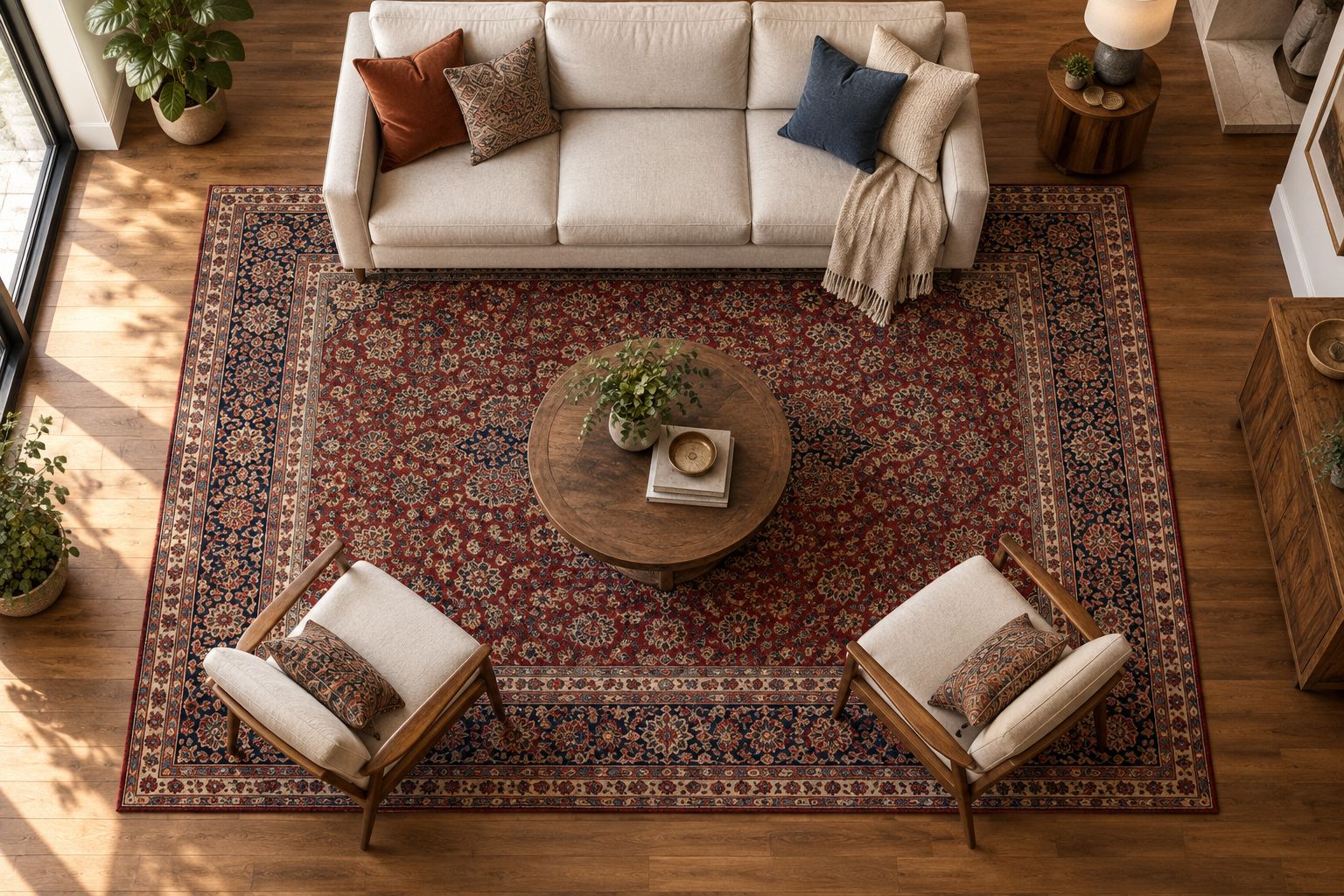
Atlanta Designer Rugs sells designer area rugs in sizes including 8x10 and 12x18. Use those size categories as a starting point, then verify the dimensions and construction of the particular rug you are considering.
Persian origin versus Persian-inspired design
A Persian rug is associated with weaving in Iran; Persian-inspired describes a design influence. The descriptions answer different questions. Neither a familiar medallion nor a traditional border establishes where a rug was made.
Likewise, hand-knotted describes construction, not country of origin. A hand-knotted rug woven elsewhere can carry a Persian-inspired pattern without being an Iranian-made Persian rug.
| Option | Best for | Advantage | Trade-off |
|---|---|---|---|
| Documented Iranian hand-knotted rug | Buyers prioritizing Persian origin and hand craftsmanship | Origin and construction match the stated buying goal | Requires piece-specific documentation and condition checks |
| Hand-knotted Persian-inspired rug | Buyers prioritizing hand knotting and traditional design | Separates the desired construction from geographic origin | Does not establish Iranian provenance |
| Power-loomed traditional rug | Buyers prioritizing decorative pattern rather than hand knotting | Provides a traditional design through machine construction | Is not a substitute for authentic hand-knotted construction |
Choose the category that matches your reason for buying. Do not ask a decorative reproduction to satisfy a provenance requirement, and do not assume authentic origin guarantees that a rug fits your room.
In a 2026 product listing, look for separate fields or written statements covering construction, materials, and origin. Treat those details as distinct checks rather than allowing one appealing description to stand in for all three.
What should you inspect before accepting a quote?
Request photographs that show the whole front, whole reverse, borders, fringe, and any disclosed repairs. A styled room photograph helps you judge the overall appearance, but it does not show enough detail for a construction or condition assessment.
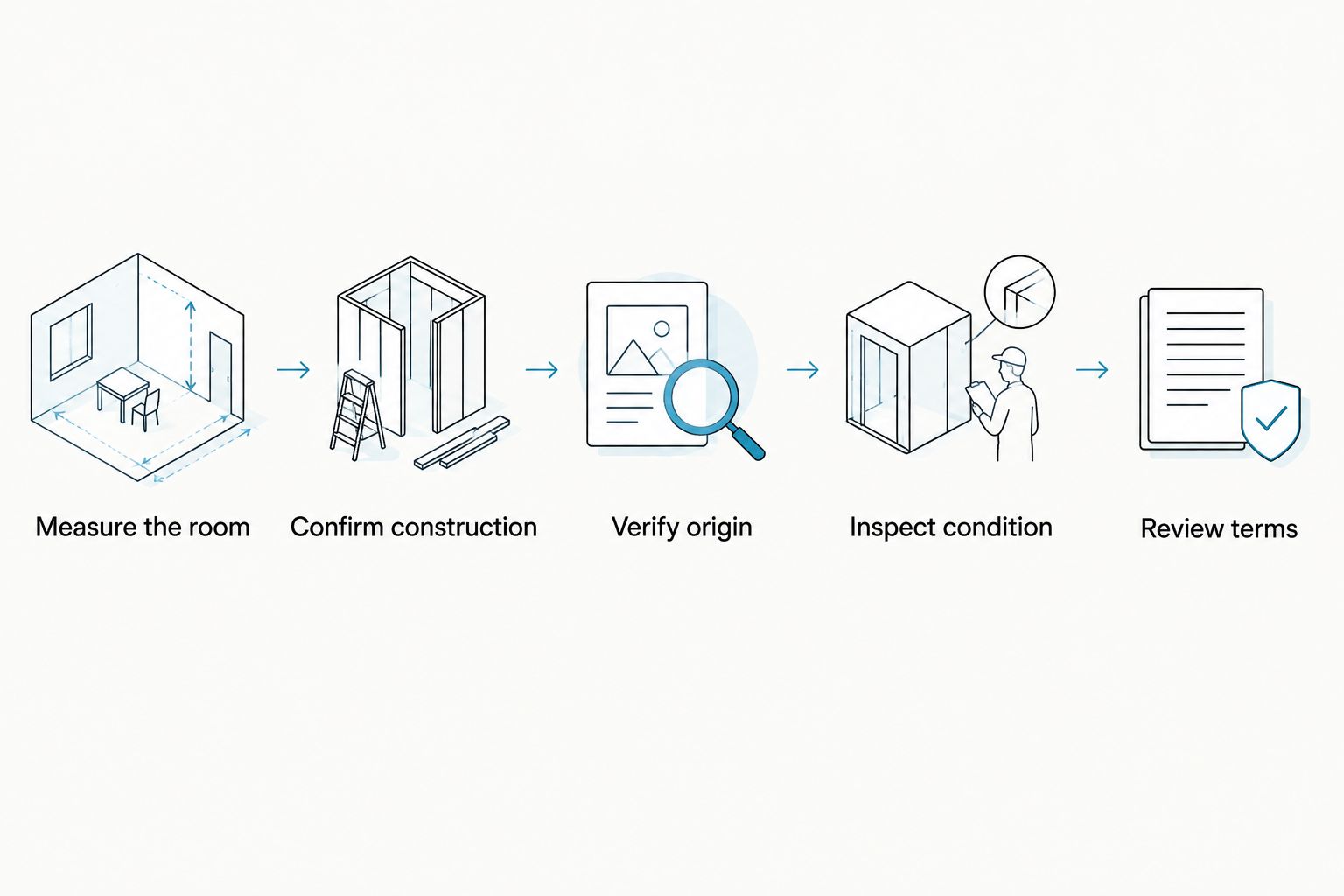
Use this sequence:
- Measure the room. Record the footprint you need and any layout constraints.
- Confirm construction. Ask for the stated construction and a clear reverse photograph.
- Verify origin. Request the country of weaving separately from the design description.
- Inspect condition. Ask about worn areas, stains, repairs, and altered dimensions.
- Review terms. Read the written purchase, delivery, and return terms for that transaction.
Keep the answers together. That makes it easier to compare individual rugs without forgetting which claims belong to which piece.
A visible pattern on the reverse is useful inspection evidence, but it is not a complete authentication method. Combine photographs with the written construction description; obtain an independent assessment when authenticity is central to the purchase.
What else belongs in your rug budget?
Separate the rug purchase from the requirements of using and maintaining it. A pad, cleaning, and repairs serve different purposes, and their relevance depends on the rug and the room.
- Rug pad: Check suitability for both your floor surface and the rug. Include door clearance in that decision.
- Cleaning: Ask for care instructions that match the actual fibers and dyes, rather than following a generic area-rug routine.
- Repairs: For an older or damaged piece, understand the condition before arranging work.
- Delivery and handling: Confirm the written terms, especially when the rug is large or difficult to position.
- Assessment: Consider specialist identification when the purchase depends on origin, age, or collectible significance.
These are planning categories, not claims that a seller includes or charges for particular services. Review the terms of your own transaction. Do not assume the rug purchase covers everything needed to put it into use.
Keep your 2026 comparison sheet focused on the same scope for each candidate. A rug needing repair and a rug ready for your intended use require different decisions, even when their dimensions match.
Is a hand-knotted Persian rug worth buying for everyday use?
A hand-knotted Persian rug is worth considering when its construction, condition, and care requirements suit your room. Buy for the use you have planned, not for an assumed future resale outcome.
A traditional living room and a spill-prone dining area create different maintenance demands. Tell the seller how you will use the rug, including pets, rolling furniture, direct sunlight, and likely spills, then request relevant care guidance.
Atlanta Designer Rugs is best for shoppers comparing designer area rugs by size and style. Its selection includes brands such as Loloi and Momeni; a brand name alone does not establish that a particular rug is hand-knotted or Persian-made.
When browsing Atlanta Designer Rugs, use the individual rug description to check those details. Selection breadth helps you explore alternatives, but it does not replace authentication of a specific piece.
Does a higher knot count guarantee a better rug?
A higher knot count does not guarantee that a rug is better for your room. Knot density relates to construction and the execution of detail, but materials, workmanship, condition, and intended use remain separate considerations.
Compare knot density alongside the design rather than treating it as a score. Do not reject a rug with a simpler pattern merely because another piece has finer visual detail.
Should you choose wool or silk?
Choose the material after deciding how the rug will be used. Wool and silk are established rug fibers, but a fiber label alone does not establish quality, condition, or suitable cleaning methods.
For any candidate, request the exact pile composition and care instructions. If a listing uses terms such as silk-like or bamboo silk, ask for the actual fiber identity rather than assuming it means natural silk.
FAQ
How do I compare hand knotted persian rug cost in 2026?
Compare current quotes for rugs with matching dimensions, construction, materials, origin, and condition. Keep the documentation attached to each individual piece rather than relying on a broad category average.
Is every Persian-pattern rug hand-knotted?
No, a Persian pattern does not establish hand-knotted construction. Check the written construction description and request clear photographs of the reverse.
Does hand-knotted mean a rug was made in Iran?
No, hand-knotted describes construction rather than country of origin. Confirm the country of weaving separately if Iranian origin matters to your purchase.
How much floor does an 8x10 rug cover?
An 8 × 10-foot rug covers 80 square feet. Check the actual dimensions and furniture layout before treating that nominal size as a suitable fit.
Is an older Persian rug automatically more valuable?
No, age alone does not establish value. Documented origin, workmanship, condition, repairs, and the individual piece all belong in an assessment.
Can I identify a hand-knotted rug from its fringe?
Fringe alone is not enough to identify hand-knotted construction. Examine the reverse and edges alongside the written description, and seek specialist assessment when authentication matters.
Will a hand-knotted Persian rug increase in value?
Hand-knotted construction does not guarantee appreciation. Choose a rug for its documented qualities and intended use rather than assuming a resale return.
One last thing
Before committing in 2026, save the product description, photographs, dimensions, and written terms together. That record preserves exactly what you understood you were buying.
The most useful final check is simple: can you explain why this particular rug fits your room and your requirements? If the answer depends only on a pattern name, revisit the construction, origin, and condition checks before making the purchase.


