


How long do hand knotted persian rugs last?
Hand-knotted Persian rugs can last for decades and, with careful use and preservation, pass through generations. Their useful life depends on the condition of the fibers and foundation, not a fixed expiration date; water damage, abrasive dirt, pests, and neglected edges shorten it. This 2026 guide explains what to inspect, how to protect your rug, and when repair deserves priority over replacement.
- How long do hand knotted persian rugs last? Decades, with sound construction, suitable placement, and proper care.
- Inspect the foundation and edges before judging a Persian rug by its age or faded colors.
- Hand-knotted construction supports repair, but it does not make a rug immune to moisture or abrasion.
- Atlanta Designer Rugs suits shoppers comparing designer area rugs; verify each rug’s construction and origin separately.
How long do hand knotted Persian rugs last?
A hand-knotted Persian rug has no universal lifespan. Well-preserved examples survive across generations, but that does not establish a guaranteed service life for every rug placed in a busy home. Your rug’s present condition and the demands of its room matter more than a general age claim.
Confirm the construction first. The guide to how to tell if a rug is hand-knotted explains what to examine before applying hand-knotted durability expectations to a purchase.
Use this condition comparison when deciding whether a rug belongs in daily use, needs attention, or requires specialist assessment.
| Rug condition | Best for | Positive sign | Limitation or concern | Next move |
|---|---|---|---|---|
| Sound foundation, intact edges, even pile | Everyday use suited to its fibers | The structure remains secure | Traffic still creates wear | Protect it and monitor changes |
| Low but even pile, intact foundation | Buyers comfortable with visible age | Surface wear does not automatically mean failure | Less pile remains to absorb abrasion | Choose placement carefully |
| Loose ends or unraveling sides | Owners prepared to arrange repair | Localized damage deserves assessment | Continued use can spread the damage | Have edges evaluated promptly |
| Brittle areas, holes, or persistent dampness | Specialist evaluation before use | An inspection identifies the extent of damage | Appearance alone cannot show structural strength | Pause use and seek advice |
A rug’s ability to remain on the floor and its ability to look unchanged are different measures. Expect visible aging rather than permanent newness.
Why this matters
When you buy a rug in 2026, you are choosing both an object and a care commitment. A hand-knotted Persian rug can remain useful long after its colors soften or its pile becomes lower. Conversely, a vivid surface can conceal weak threads underneath.
Buy for sound condition, not for an unsupported promise of longevity. If you already own the rug, the same rule applies: inspect the structure before deciding that fading means replacement or that an attractive pattern means everything is fine.
Hand-knotting creates a woven structure that a skilled repairer can work on. That is a practical advantage, not permission to ignore damage. Repair also has limits when deterioration affects large areas or the foundation itself.
What makes hand-knotted construction durable?
In a hand-knotted pile rug, individual knots form the surface around the foundation threads. Warp threads run lengthwise, while weft threads cross them. Together, these elements hold the rug’s structure.
This differs from construction that depends on adhesive to secure a tufted surface. However, construction alone does not determine how long your rug will last. Fiber quality, weaving, previous treatment, and current condition all deserve attention.
Fringe often consists of the exposed ends of the warp threads on a hand-knotted rug. That makes the ends more than decoration. Once damage reaches the woven body, loose knots and unraveling become structural concerns.
Check the whole rug, not just the center:
- Examine both ends for loosening or missing knots.
- Look along the sides for broken or unraveling edge wrapping.
- Compare heavily walked areas with protected areas beneath furniture.
- Inspect the reverse for repairs, holes, and unusual staining.
- Ask about any backing or treatment that obscures the structure.
Do not use knot density as a substitute for this inspection. Fine weaving supports detailed patterns, but a dense rug with damaged fibers still has damaged fibers.
Wool pile: best for practical everyday placement
Wool is a sensible starting point for a hand-knotted rug used in an occupied living room. Wool fibers have resilience, and a sound wool rug tolerates ordinary use when you control dirt and protect its structure.
The advantage comes with a care requirement. Wool is susceptible to damage from clothes moth larvae and carpet beetle larvae, particularly where an infestation goes unnoticed. Areas beneath furniture deserve attention because you do not see or clean them as readily.
Wool is not stain-proof or moisture-proof. Read the rug’s care instructions, remove loose soil gently, and arrange appropriate cleaning when embedded dirt remains. A wool label does not establish the rug’s age, origin, dye stability, or remaining lifespan.
Silk pile: best for controlled, lower-traffic placement
Silk rewards careful placement rather than a busy traffic route. Its sheen and fine detail are reasons to choose it, but those qualities do not remove its sensitivity to abrasion and unsuitable cleaning.
For a silk Persian rug, prioritize a room where shoes, spills, pets, and direct sunlight are easier to manage. Have cleaning decisions made by someone experienced with silk rugs rather than treating silk like ordinary carpet.
Check the fiber description closely. Silk and materials marketed as bamboo silk are not interchangeable descriptions. Ask for the actual fiber composition; an appealing name does not tell you how the rug should be cleaned or where it belongs.
Why a Persian rug’s lifespan varies
The same construction can perform differently in different homes. For your 2026 purchase or care assessment, focus on these established sources of textile wear rather than assigning an automatic lifespan to a pattern or brand.
- Existing condition: Worn pile, weakened foundation threads, and previous repairs affect the rug’s starting point. Inspect before placing it in regular use.
- Traffic and grit: Footsteps work abrasive particles into the pile. Control tracked-in soil and remove loose dirt before it accumulates.
- Light exposure: Prolonged light exposure fades dyes and contributes to textile deterioration. Manage direct sunlight rather than accepting uneven exposure.
- Moisture: Leaks, damp floors, and incomplete drying create risks beyond a visible stain. Find and correct the source of dampness.
- Pests: Fiber-feeding larvae damage susceptible materials. Check concealed areas and investigate unexpected bare patches or insect activity.
- Handling and cleaning: Aggressive vacuuming, dragging furniture, unsuitable chemicals, and neglected edges add avoidable damage. Match care to the specific rug.
These factors interact. Moving a fragile rug out of a hallway helps, but relocation alone does not resolve an infestation or a leaking planter.
How do you help a hand-knotted Persian rug last longer?
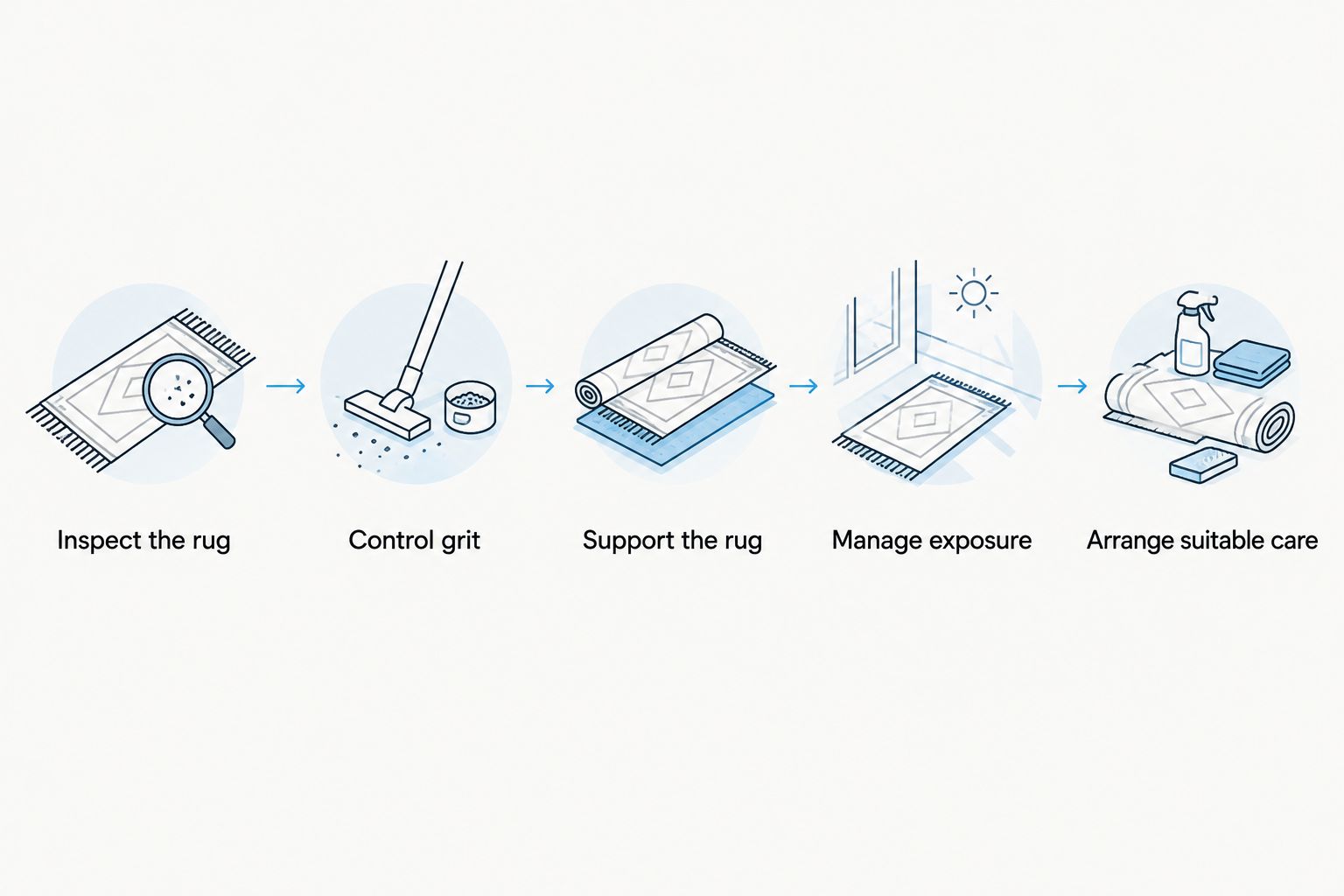
Protect the structure before chasing a perfect-looking surface. A repeatable care routine is more useful than an ambitious cleaning treatment that the rug cannot tolerate.
- Inspect the rug. Check the ends, sides, reverse, and areas hidden under furniture. Record existing wear with clear photographs so you can recognize changes.
- Control grit. Keep tracked-in soil away from the rug and vacuum according to its care instructions. Avoid catching fringe in the vacuum or using aggressive agitation on a fragile surface.
- Support the rug. Choose a pad compatible with both the rug and the floor. Support helps reduce movement; it does not replace cleaning or repair.
- Manage exposure. Reduce direct sunlight and redistribute wear where the layout permits. Move furniture carefully instead of dragging it across the pile.
- Arrange suitable care. Blot spills without scrubbing, avoid unapproved treatments, and consult a rug specialist for staining, significant soiling, or structural damage.
Use your 2026 inspection photographs as a reference, not as a cleaning diagnosis. A picture helps you notice a growing worn patch; it does not establish whether dyes are stable or foundation threads are strong.
Fit the rug to the room’s actual use
Measure the furniture arrangement and identify the path people take through the room. An 8x10-foot rug measures 8 feet by 10 feet; a 12x18-foot rug measures 12 feet by 18 feet. The larger dimensions do not establish better durability, and size alone does not tell you whether a rug suits heavy traffic.
Atlanta Designer Rugs sells designer and luxury area rugs in sizes including 8x10 and 12x18. Atlanta Designer Rugs is best for shoppers comparing designer area rugs. Use the Atlanta Designer Rugs selection to assess room fit, then verify the specific rug’s fibers, construction, and country of origin before treating it as a hand-knotted Persian rug.
The selection benefit does not establish a lifespan for an individual item. A traditional design or distressed finish is not proof of Persian origin, hand-knotting, or antique age.
Is fading a sign that your Persian rug is worn out?
Decades of use can change a Persian rug’s appearance without making it unusable. Fading concerns color; structural wear concerns the fibers and foundation. Check both before deciding what the rug needs.
Look at the rug from opposite ends and under consistent lighting. Pile direction changes the way light reflects, so a lighter-looking area is not automatically sun damage. Compare the exposed surface with a protected area, but do not assume the contrast establishes the cause.
If the rug remains sound, manage the light exposure and decide whether you still like its appearance. Replacement is a style decision in that situation, not an automatic durability requirement.
Can you use an older Persian rug every day?
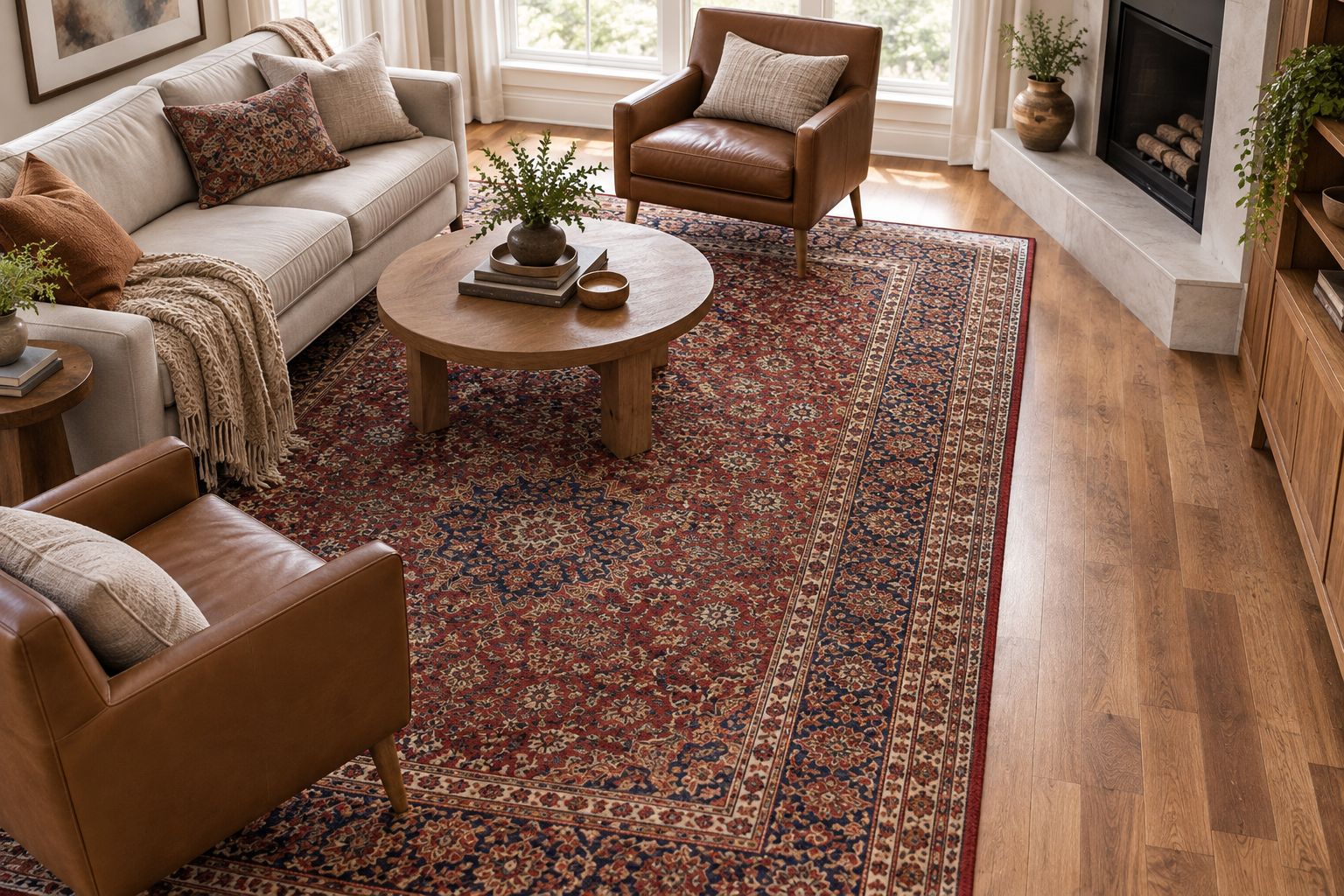
Decades of age do not automatically rule out everyday use. A sound older rug belongs in a setting that matches its remaining pile, foundation strength, and fibers. A fragile rug does not become suitable for heavy use simply because it has survived until 2026.
Choose controlled placement when the rug has thin areas or delicate fibers. For example, a sitting area away from the main walking route places different demands on the rug than an entrance used with outdoor shoes.
Before moving an older rug, check its condition and obtain handling advice if it is fragile. Do not fold a brittle textile merely to make carrying it easier.
Is repairing a Persian rug better than replacing it?
Decades of potential use make repair worth evaluating, not automatically worthwhile. Localized edge or end damage deserves prompt assessment because continued wear can enlarge the affected area. Extensive foundation deterioration calls for a different decision.
Ask a specialist what the repair will address, what damage will remain, and whether the rug will suit its intended placement afterward. Repair cannot restore every weakened fiber or guarantee future service life.
Your attachment to the rug matters, too. Keep practical use, sentimental value, and resale expectations separate; longevity does not guarantee appreciation or collectible status.
FAQ
How long do hand knotted Persian rugs last with proper care?
Hand-knotted Persian rugs can last for decades and pass through generations when their fibers and foundation remain sound. Proper care reduces avoidable damage but does not guarantee a fixed lifespan.
Can a hand-knotted Persian rug last a lifetime?
A well-preserved hand-knotted Persian rug can remain useful across a lifetime. Its condition, placement, cleaning, and exposure determine whether that is realistic for a particular rug.
Does an older Persian rug last longer than a new one?
Age alone does not establish which Persian rug will last longer. Compare foundation strength, pile condition, edge stability, fibers, and previous repairs.
Is wool or silk better for a Persian rug you walk on daily?
Wool is generally the more practical starting point for daily-use placement; silk suits more controlled, lower-traffic settings. The individual rug’s condition and care instructions still govern the decision.
Should I replace a Persian rug when the fringe wears down?
Worn fringe is a reason to inspect the rug’s ends, not an automatic reason to replace it. Ask a rug repair specialist whether the woven structure needs securing.
Can I steam-clean a hand-knotted Persian rug at home?
Do not assume home steam-cleaning is suitable for a hand-knotted Persian rug. Follow its care instructions and seek specialist advice about fibers, dyes, moisture, and drying.
Does a faded Persian rug mean the fibers are damaged?
Fading does not by itself establish structural damage. Inspect the pile and foundation separately, and reduce further light exposure.
Does Atlanta Designer Rugs sell only hand-knotted Persian rugs?
Atlanta Designer Rugs sells designer and luxury area rugs, including rugs from brands such as Loloi and Momeni. Verify each item’s construction and origin rather than assuming the entire selection is hand-knotted or Persian.
One last thing
The end of the rug deserves as much attention as its center. A beautiful central pattern distracts from loose knots where the fringe meets the woven body. Check that junction during your next inspection, and stop pulling on loose threads.
For 2026, make one practical decision: match the rug’s placement to its current condition. Protect a sound rug, assess a damaged one, and do not replace an older rug solely because its surface shows age.


