


Damaged rug delivery to a resolved warranty claim: 2026 workflow
Instead of chasing photos, order details, and separate messages after a damaged rug arrives, organize your damaged rug delivery warranty claim into one evidence file and one written conversation. This 2026 workflow takes you from inspection to a documented decision without assuming that delivery damage qualifies for warranty coverage.
- For an Atlanta Designer Rugs order, report delivery damage with order details, packaging photos, and rug photos.
- A damaged rug delivery warranty claim needs the correct route: shipping damage and manufacturing defects are different issues.
- Keep packaging and pause cleaning or repairs while you request written handling instructions.
- Close the claim after the agreed remedy is completed, not simply when your message receives a reply.
Why this matters
A torn shipping wrapper, a cut rug edge, and a construction problem require different descriptions. Calling every issue a warranty defect skips the first task: establishing what arrived, what you observed, and when you observed it.
Atlanta Designer Rugs is best for shoppers seeking luxury area rugs from brands such as Loloi and Momeni. For a purchase from Atlanta Designer Rugs, use the seller information in your order confirmation to start the reporting process; do not assume a particular remedy or manufacturer warranty applies.
The benefit of this workflow is a clear record that another person can review without reconstructing your delivery. Its limitation is equally clear: organized evidence does not establish coverage or guarantee approval. The applicable purchase terms, shipping instructions, and warranty terms govern the decision.
Before you start
- Gather purchase and delivery records. Have your order confirmation, exact rug identification, tracking information, delivery date, and the seller contact details supplied with your purchase. Use the email account associated with the order when possible.
- Prepare inspection materials. Use a camera or phone, a measuring tape, and a clean inspection area. Keep original photo files, the rug label, and packaging; ask for help handling a rug you cannot safely move alone.
- Check the reporting route before changing the rug. Read the applicable damage-reporting and warranty instructions. Delivery damage is not automatically a manufacturing defect, and cleaning, trimming, repair, or unauthorized return shipment changes the condition being reviewed.
For a 2026 purchase, save the terms provided with that order alongside the confirmation. Follow the stated reporting deadline; do not substitute a generic deadline from an unrelated retailer or rug brand.
Delivery evidence file
Your first configuration unit is the evidence file. Build it before arranging the room, placing furniture, or attempting to correct the problem.
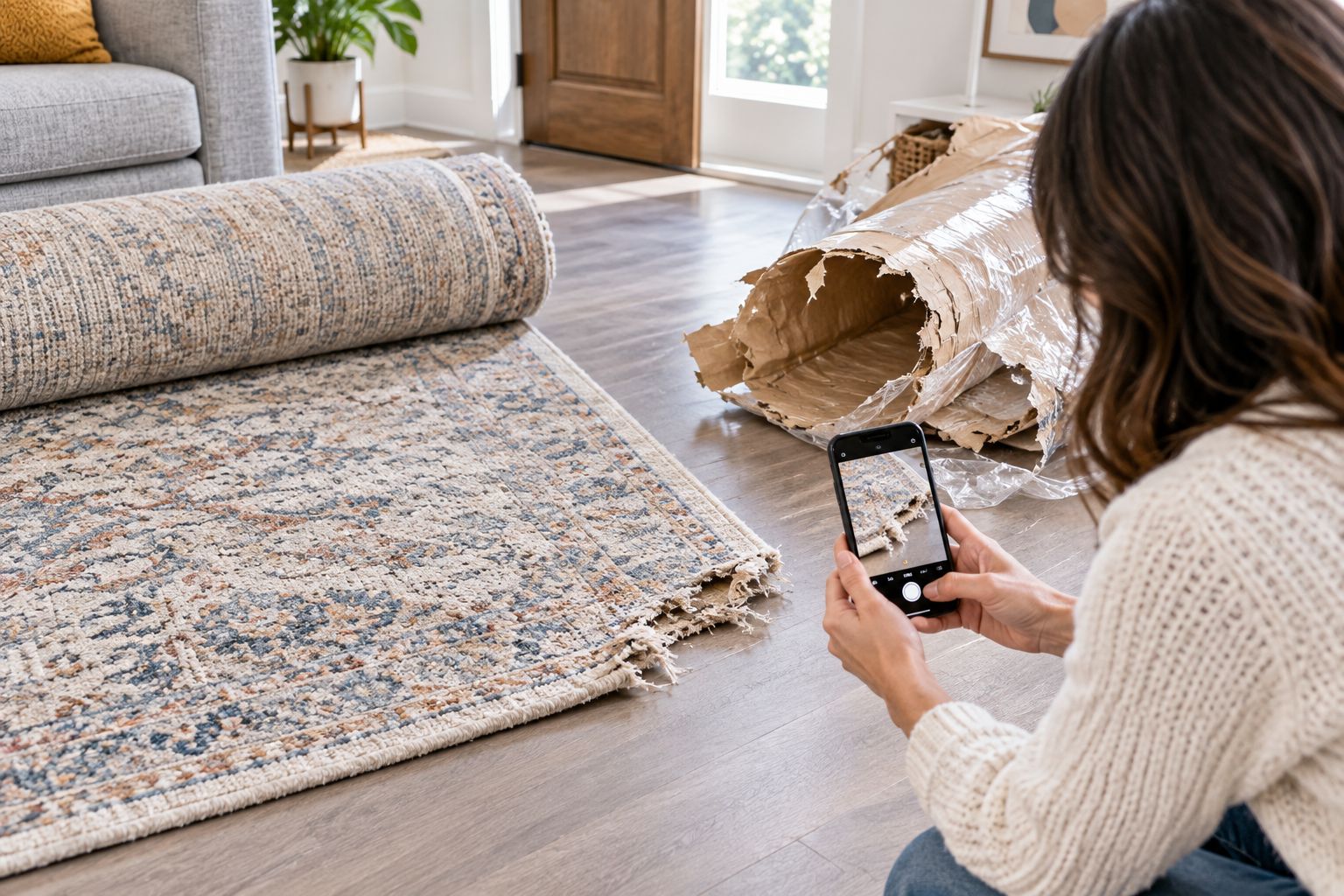
- Photograph the package. Capture the wrapper, carton, exposed ends, shipping label, and visible punctures or moisture before further unpacking. If you already opened it, photograph what remains and state that the photos were taken after opening.
- Inspect without altering. Unroll only as far as needed for a safe inspection. Photograph the face, backing, edges, and label without cutting loose yarns, applying cleaner, steaming, or attempting repairs.
- Connect the damage to its location. Take 4 photo types as your starting checklist: package exterior, full rug, affected area, and product label. Add 2 views of the affected area—one close-up and one wider view showing where it sits on the rug.
- Write the delivery sequence. Record when delivery occurred, when unpacking began, when you noticed the issue, and anything you did afterward. Separate observed facts from assumptions about the cause.
Expected result: Your evidence shows which rug arrived, its packaging condition, and the location of the reported problem.
A useful description names a visible condition: a split edge, a cut in the backing, or a wet area. Avoid declaring that a carrier or manufacturer caused it unless you have evidence supporting that statement.
File names that make review easier
Use descriptive names such as package exterior, rug overview, edge close-up, and rug label. Keep an untouched copy of each original image; mark a duplicate if you need to point out a small defect.
For your 2026 claim folder, place the order confirmation and delivery record beside the photographs. This is a filing recommendation, not a required seller format.
Do not crop away surrounding details from every image. A close-up shows the problem, while a wider view connects it to the rug and helps distinguish separate damaged areas.
Claim route and written report
The next configuration unit is the report. Start with the seller listed on your purchase record and ask which process applies to the observed condition.
Choose the route by evidence, not by the desired outcome
| Reporting route | Best for | Advantage | Limitation |
|---|---|---|---|
| Delivery-damage report | Damage observed during delivery or initial unpacking | Records the arrival condition and packaging evidence | Does not by itself establish who caused the damage |
| Manufacturer-warranty inquiry | A suspected construction or manufacturing defect | Asks for review under the applicable warranty terms | Coverage depends on those terms and the assessed cause |
| Product-condition question | An uncertain mark, texture, crease, or appearance difference | Requests assessment before you alter the rug | An explanation is not the same as an approved claim |
These routes are reporting categories, not promises that a seller offers every remedy. Report what you observed first; ask the seller to confirm how it should be classified.
- Identify the purchase. Include the order number, exact product name, selected size, delivery date, and purchaser name. Copy these from your records rather than relying on memory.
- Describe the condition. State where the problem appears and when you first noticed it. Explain whether packaging was visibly damaged and whether the rug has been used, cleaned, or altered.
- Attach the evidence. Send the package photo, rug overview, affected-area photos, and label photo together. Use the attachment method specified by the recipient and verify that the files are accessible.
- Request the next action. Ask which reporting process applies, what additional evidence is needed, and how to preserve the rug and packaging during review.
Expected result: The recipient can connect the report to your order and tell you the next required action.
Build the message around facts
Use a subject line containing the order number and a short description of the issue. This is a suggested email format, not the name of a store portal field.
Keep the message body in this order:
- Purchase: Exact rug identification and order number.
- Delivery: Delivery date and inspection sequence.
- Condition: Visible problem and location on the rug.
- Evidence: List of attached files.
- Request: Review instructions and confirmation of the reporting route.
For an Atlanta Designer Rugs luxury area rug order, copy the purchased size and product identification directly from the confirmation. Similar collection names or color descriptions are not a substitute for the ordered item.
Claim tracking record
A sent message starts the process; it does not prove that the report reached the right recipient. Track acknowledgment, evidence requests, and handling instructions separately.
- Keep 1 main conversation. Reply within the existing thread when practical. If the recipient requires a different channel, include the original reference so the records remain connected.
- Record the acknowledgment. Save any case reference and the named contact or department. Ask who is responsible for the next action if that is unclear.
- Log each request. Record the requested evidence, the date requested, your response, and the next action. Copy a stated response date exactly; do not create a deadline on the recipient's behalf.
- Follow up with a specific question. If a stated response date passes, ask what remains outstanding and who will provide the next update. Include the order and case references.
Expected result: Your record distinguishes a submitted report, an acknowledged report, an evidence request, and a decision.
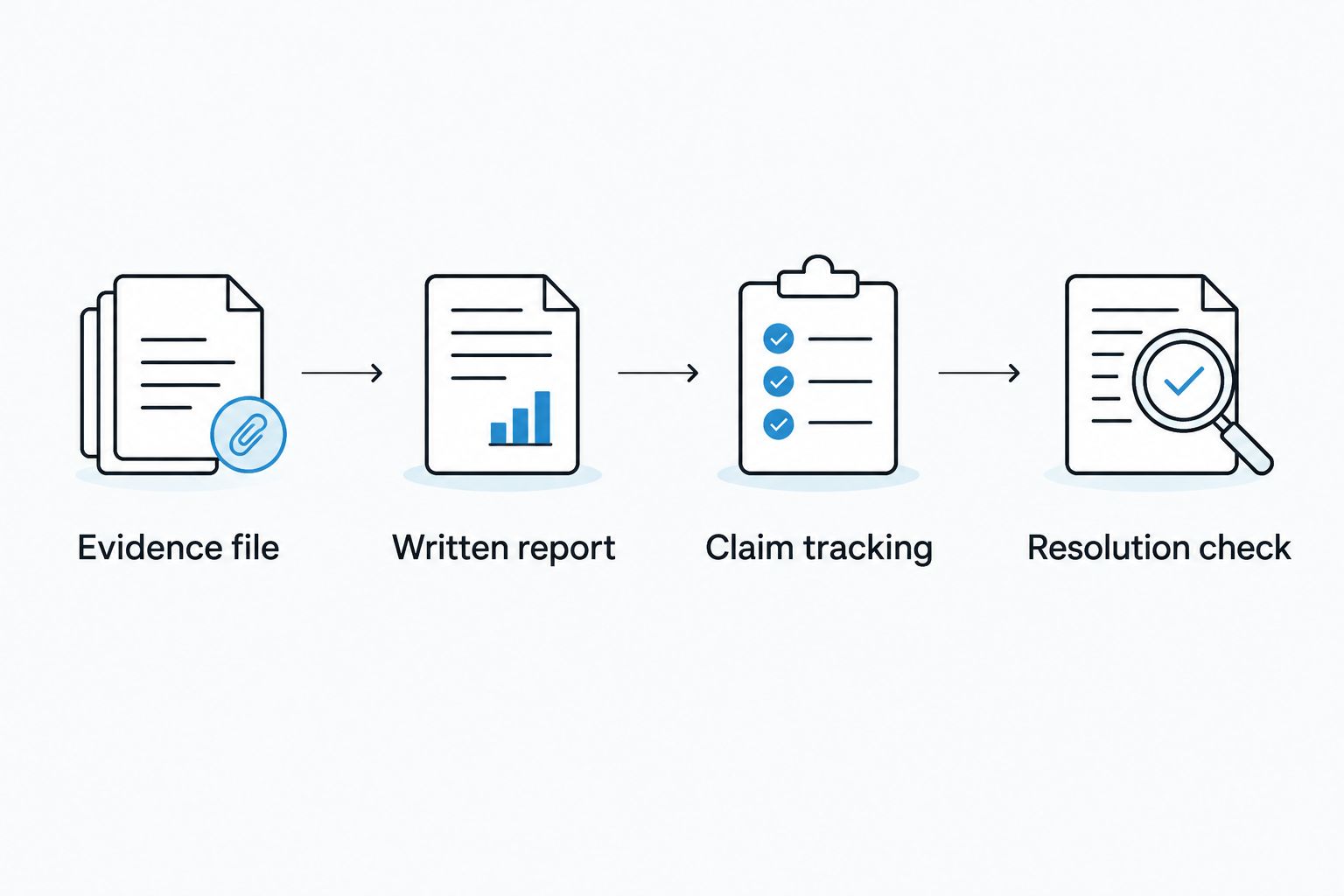
A simple tracking document needs these headings: Evidence file, Written report, Claim tracking, and Resolution check. Record actual dates beneath them, including 2026 where that is the year of the event.
Preserve the condition while review continues
Keep the rug out of normal use while you request instructions. Do not place furniture over the affected area or discard packaging simply because you have received an acknowledgment.
If the rug or packaging is wet, contaminated, or unsafe to handle, photograph the condition and request handling guidance promptly. Do not leave a wet rug against a vulnerable floor solely to preserve evidence.
Record any action taken to protect people or property. The goal is an accurate account, not an untouched item at the expense of safety.
Resolution check
The final configuration unit is the outcome record. A claim is resolved when the agreed action is completed, not when someone says the claim is under review.
- Obtain the written decision. Ask what was decided, why, and what action is authorized. Separate a proposed remedy from one you have accepted.
- Confirm logistics before shipping. If a return or collection is authorized, obtain the destination, packing instructions, required authorization, and responsibility for arranging transport in writing.
- Verify completion. For an agreed replacement, check its identity and condition on arrival. For another agreed remedy, retain confirmation that the stated action was completed.
- Save the closing record. Keep the decision, your acceptance, shipping records where relevant, and completion evidence together. Note any unresolved part of the issue rather than marking the whole claim closed.
Expected result: You have a documented outcome and evidence that the agreed action occurred.
If the decision is a denial, ask for the applicable reason and term in writing. Address a factual error with supporting evidence; repeating the original complaint without new information does not clarify the disputed point.
For a claim completed in 2026, put the actual completion date in the record. A promised action and a completed action should have separate entries.
Report a suspected defect discovered after delivery
Use an adjacent workflow when the rug looked intact during unpacking but a problem appears later. Do not describe later discovery as arrival damage unless your records support that account.
Start with the same order identification and photographs. Add the date first noticed, where the rug has been used, relevant care history, and any event connected to the change.
Then request review under the applicable product terms. Include the manufacturer's identity as shown on the product or purchase record, without assuming that different brands share warranty coverage.
Best for: A suspected manufacturing or construction issue discovered after initial inspection. The advantage is a record that includes use and care history; the limitation is that photographs alone do not establish the cause.
Keep the later report connected to any earlier condition inquiry. That preserves the sequence without rewriting what happened at delivery.
Troubleshooting
The photos do not show the problem clearly
Retake the affected area in even light and include a wider view. For a backing or edge issue, photograph that surface directly rather than relying on a face-up room photo.
Keep the original files. Image compression and screenshots can remove detail needed to assess a small cut or split.
The recipient cannot open the attachments
Ask for the accepted file format and submission method. Resend the requested files through that method, then ask for confirmation that they are readable.
Do not assume an attachment arrived because the email was delivered. A readable message and accessible evidence are separate checks.
The packaging has already been discarded
Report that fact accurately and submit the remaining evidence. Include any earlier delivery photographs and the rug's current condition.
Do not recreate damaged packaging or present a staged image as delivery evidence. Ask what alternative documentation is acceptable.
The report keeps moving between seller and manufacturer
Ask each recipient to identify the required next action and responsible party in writing. Keep the same purchase identification and evidence set across the conversations.
A referral is not a decision. Request clarification about where the review stands before treating the claim as rejected or approved.
The proposed remedy has unclear return instructions
Pause shipment and request written packing, destination, and authorization instructions. Confirm transport responsibility before arranging collection yourself.
Keep the dispatch record and tracking information if shipment is authorized. Do not close the file before the agreed outcome is complete.
Customize your workflow
For designers managing several installations, keep a separate record for each order and identify the receiving person. Ask that person to document unpacking before furniture placement so you receive evidence tied to the correct room and rug.
For a replacement delivery, repeat the inspection rather than relying on the previous claim's approval. The white-glove rug delivery setup workflow is a related planning guide; consult your actual order arrangements to establish which delivery services apply.
For Atlanta Designer Rugs luxury area rug purchases, this documentation process supports clear communication. It does not replace the terms supplied with the order.
FAQ
What should I do first if my rug arrives damaged?
Photograph the packaging and rug, retain the purchase records, and report the observed condition through the seller contact supplied with your order. Avoid cleaning or repairing the affected area while you request handling instructions.
Is shipping damage covered by a rug warranty?
Shipping damage is not automatically covered by a manufacturer warranty. Ask the seller which process applies and check the applicable shipping and warranty terms.
What photos should I send for a damaged rug delivery warranty claim?
Send packaging photos, a full-rug view, affected-area photos, and the product label. Include both a close-up and a wider view so the recipient can identify the problem and its location.
Should I clean a stained rug before reporting delivery damage?
Document the stain and request instructions before cleaning it. Cleaning changes the condition under review, so disclose any treatment already performed.
Can I report damage if I already threw away the packaging?
Report the damage and state that the packaging was discarded. Submit the evidence you still have and ask what alternative documentation the recipient accepts.
Should I contact the seller or rug manufacturer first?
Start with the seller information in your purchase record and ask for the applicable reporting route. Follow any order-specific instructions that direct the report elsewhere.
When is a damaged rug claim actually resolved?
A claim is resolved when the agreed remedy is completed and documented. An acknowledgment, review update, or proposed remedy is not the same as completion.
One last thing
Keep the replacement inspection separate from the original damage report. Photograph the replacement's label and condition, then connect that record to the original case. A resolved claim should show both what went wrong and what ultimately arrived.


