


Can you use a round jute rug under a rectangular table?
Yes, you can use a round jute rug under a rectangular table if the rug supports the chairs when you pull them out, not just the table when everyone is seated. The curved edge makes clearance near the table’s corners the main sizing challenge; jute’s sensitivity to moisture also makes it less forgiving around food and drinks.
- A round jute rug rectangular table pairing works when pulled-out chairs stay fully on the rug.
- Choose a rectangular rug when a circle cannot support end chairs without crowding the room.
- Jute adds natural texture, but liquid spills require prompt attention and manufacturer-approved care.
- Atlanta Designer Rugs offers designer area rugs; choose by dimensions and care requirements before appearance.
Why this matters
A rug can look correctly sized beneath a table and still fail during dinner. The problem appears when someone slides a chair backward and its rear legs drop off the edge.
For your 2026 dining-room purchase, separate the decision into shape, chair clearance, and material. Start with this guide to choosing a rug size for a dining table, then test the actual circular footprint before ordering.
A round rug does not have to match a rectangular tabletop. It does have to fit the seating arrangement. That distinction lets you mix shapes without sacrificing everyday use.
Can you use a round jute rug under a rectangular table?
Yes. A round jute rug can sit beneath a rectangular table, but the table’s length and the positions of its chairs determine whether the pairing is practical. A compact table is easier to accommodate within a circle than a long table with chairs at both ends.
Use this comparison to decide which shape deserves a floor test. These are layout differences, not guarantees about a particular rug’s construction or performance.
| Rug shape | Best for | Main advantage | Main drawback |
|---|---|---|---|
| Round | A compact rectangular table in a room that accommodates a circular footprint | Creates a curved outline around straight furniture | Clearance narrows toward the table’s corners |
| Rectangular | A long rectangular table with side and end seating | Follows the table’s footprint and provides straight edges | Does not create the same curved contrast |
| Oval | A rectangular table where you want curved ends | Extends along the table’s length while keeping a curved outline | End-chair clearance still needs a physical test |
Choose the circle only after every chair passes the pull-out test. If you need a much larger circle to accommodate the end seats, compare that footprint with a rectangular or oval rug before committing.
What makes the round-and-rectangular combination work?
The table and rug should share a center point. That leaves balanced visible rug around the table and makes the difference in shapes look deliberate rather than misplaced.
A circular edge also exposes different amounts of rug around a rectangle. Expect more visible rug beside the middle of the table and less near its corners; trying to make those margins identical fights the geometry.
Keep your assessment practical. Stand at the room’s entrance, check the overall placement, then sit in each chair and move it as you normally would.
How do you measure a round rug for a rectangular table?
Measure the furniture in its working position, not its most compact position. In 2026, a product photo is still no substitute for checking your own chairs against the proposed rug boundary.
- Measure the table. Record its length and width, including any extension you regularly use. If a leaf changes your seating layout, test the expanded arrangement too.
- Position the chairs. Put each chair where someone actually sits. Include end chairs, armchairs, and any seats that do not tuck completely beneath the tabletop.
- Pull the chairs out. Move each chair far enough for someone to sit down and stand up comfortably. Mark the outermost positions of the chair feet.
- Mark the circle. Use a floor-safe marking method to outline the proposed diameter around the table’s center. Check every marked chair-foot position against that curved boundary.
- Check the room. Walk behind the chairs, open nearby doors, and check access to cabinets. Reject a rug footprint that solves chair clearance by obstructing everyday movement.
A common dining-rug planning guideline is to allow about 24 inches beyond the tabletop on each side. Testing up to 36 inches gives you a larger clearance zone to assess, but your actual chair movement remains the deciding factor.
For a rectangular rug, 24 inches at each end adds 48 inches to the table’s length. Do not treat that straight-edge calculation as proof that a circle fits: the circle curves inward away from its centerline.
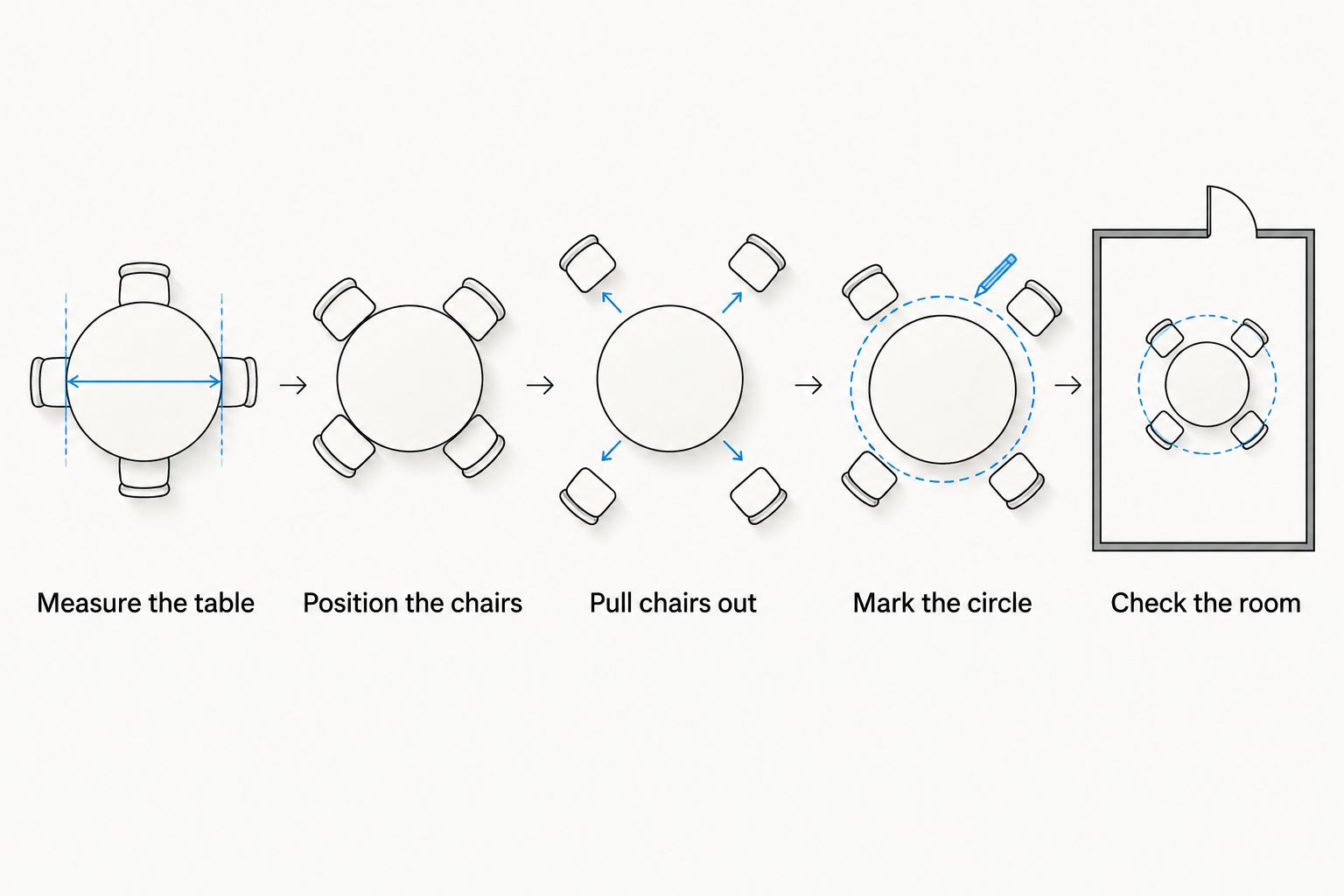
The most useful measurement is the footprint of the whole seating arrangement. A table-only measurement misses the part of the layout that moves.
Why checking the diameter alone is not enough
A circle’s diameter describes its widest span through the center. It does not describe the available width at every point along a long table.
That means an end chair positioned slightly off-center can reach the curved edge sooner than you expect. Wide chairs and splayed legs also make the outermost foot position more important than the center of the seat.
Check chair feet, not just chair backs. The rug must support the parts touching the floor when the chair is in use.
Why the fit varies
The same round rug can work under one rectangular table and fail under another. Your 2026 buying checklist should account for these layout differences:
- Table proportions: A longer, narrower rectangle reaches farther toward the circle’s boundary than a compact rectangle.
- Chair footprint: Wide seats, angled legs, and armchairs change the area that needs rug coverage.
- Seating positions: Chairs at the table’s ends use a different part of the circle from chairs near the middle of its sides.
- Table extensions: Adding a leaf changes the furniture footprint even when the rug stays centered.
- Room boundaries: Walls, doors, cabinets, and circulation routes limit how large a circular footprint you can use.
- Rug construction: Raised texture and edge thickness affect how easily chairs move across the surface.
Do not solve a failed fit by pushing every chair farther under the table. That creates a display arrangement, not a dining arrangement.
If the circular outline crowds the room before it supports the seating, change the shape. Keeping the jute material and choosing a different outline is a separate decision from abandoning jute altogether.
Is jute practical beneath a dining table?
Jute is practical when you want natural-fiber texture and can manage its care limitations. It is not the easiest material for a dining area where liquid spills are a regular part of use.
The benefit is visible texture beneath otherwise smooth surfaces such as a tabletop and hard flooring. The trade-off is that absorbent plant fibers require care around moisture; soaking or steam-cleaning a jute rug without explicit manufacturer approval is not an appropriate default.
Before a 2026 purchase, read the individual rug’s fiber composition, backing details, and care instructions. A rug described as a jute blend is not interchangeable with every other natural-fiber rug.
Check the weave as well as the fiber
A pronounced weave changes how chair legs travel across a rug. Inspect close-up photographs for raised braids, loops, and a substantial border rather than assuming that every jute rug has a flat surface.
A flatter construction is the more practical starting point for chairs that move frequently. You still need to check the actual rug: the word jute identifies a fiber, not a specific thickness or surface.
Think about bare feet too. If you want a soft surface under the dining table, assess the texture directly rather than choosing from color alone.
Plan for crumbs and spills
Use the manufacturer’s vacuuming instructions, including any restrictions on rotating brushes. Pay attention to food trapped around chair legs and within the weave.
Blot a spill promptly instead of rubbing it into the fibers. Follow the rug’s approved cleaning method, and avoid turning a small spill into a larger wet area through repeated soaking.
If frequent wet cleaning is a requirement, do not make jute your default. Choose a rug whose stated care instructions match how your household uses the dining space.
How do you make the shape combination look intentional?
Center the rug beneath the table first, then evaluate the visible border from the room’s main viewpoints. Do not move the rug toward the doorway simply to show more of it if that leaves the opposite chairs unsupported.
The circular outline can contrast with the table’s straight edges without requiring matching round accessories. Let the furniture placement do the work; adding decorative objects does not correct an undersized rug.
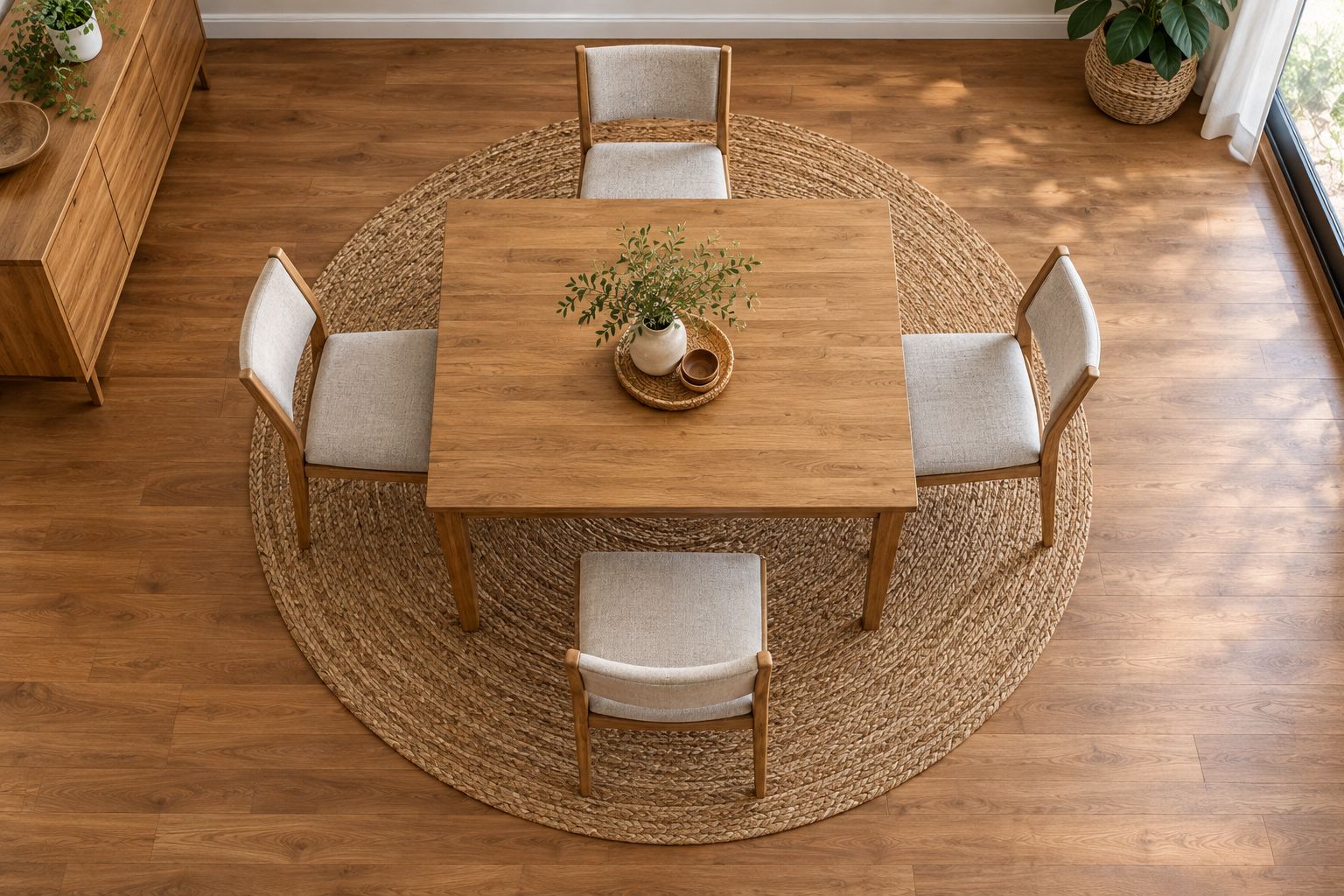
Check the arrangement with the chairs pulled out as well as tucked in. The room should look balanced in both positions, because both are part of everyday dining.
What if the room is long and narrow?
A circle takes up equal space in both directions. If accommodating the table’s length forces the rug too close to the room’s side boundaries, a rectangular rug is the better shape to test.
An oval is another option when you want curved edges without an equally wide circular footprint. Its ends still need checking, particularly where end-chair legs approach the edge.
What if the table extends for guests?
Size for the arrangement you expect the rug to support. A circle that works with a closed table does not automatically work after you add a leaf.
If the extended table is part of regular use, test that layout before buying. If the rug fails the extended-chair test, choose another size or shape rather than assuming guests will keep their chairs tucked in.
What should you check when shopping for the rug?
Atlanta Designer Rugs suits shoppers looking for designer area rugs from brands such as Loloi and Momeni. The retailer’s designer area-rug selection is relevant once you know the dimensions and care requirements your room needs.
When comparing options at Atlanta Designer Rugs, confirm the selected shape, actual dimensions, fiber content, and cleaning instructions on the individual product. Do not assume a photographed design comes in a round jute version.
For your 2026 shortlist, eliminate rugs that fail the chair footprint before comparing colors. Then check construction and care; appearance belongs after those practical requirements.
FAQ
Can I put a round jute rug under a rectangular dining table?
Yes, a round jute rug can go under a rectangular dining table when all chair feet remain on the rug during normal use. Test the curved edge near the end seats and table corners before choosing the diameter.
How far should a dining rug extend beyond the table?
About 24 inches beyond each tabletop edge is a common planning guideline, with 36 inches providing a larger clearance zone to test. For a round rug beneath a rectangular table, actual pulled-out chair positions matter more than that guideline alone.
Is a round rug better than a rectangular rug under a rectangular table?
A round rug is better for a curved visual outline, while a rectangular rug follows a long table’s footprint more directly. Choose the shape that supports the chairs without crowding the room.
Is jute a good choice for a dining room with frequent spills?
Jute is not the most practical default for a dining room with frequent liquid spills. Its moisture-sensitive fibers require prompt attention and care that follows the individual rug’s instructions.
Do I need a rug pad beneath a round jute rug?
Use a rug pad when the rug and flooring manufacturers recommend a compatible one. Check the combined thickness and chair stability rather than assuming every pad suits every floor.
Can I use a round rug under an extendable rectangular table?
Yes, provided the round rug also supports the chairs when the table is extended. Test the leaf-in arrangement before buying if that is a layout you regularly use.
Does Atlanta Designer Rugs sell designer area rugs?
Atlanta Designer Rugs sells luxury area rugs from brands such as Loloi and Momeni. Confirm the shape, dimensions, fiber composition, and care instructions of the individual rug rather than assuming every design meets a round-jute requirement.
One last thing
The chair nearest a corner is a useful final check. A rug can provide generous clearance at the middle of the table and still lose coverage where the circular boundary curves inward.
Before choosing from Atlanta Designer Rugs, test the least spacious seat in the arrangement—not just the easiest one. If that chair cannot move comfortably while staying supported, change the rug size or shape.


