


Area Rugs for Retail Stores: Choose by Zone in 2026
Retail store owners’ area rug selection is the process of matching rugs to customer zones, with the aim of defining displays and seating without obstructing movement. For area rugs for retail stores, start with placement, secure edges, and cleaning requirements—not pattern alone—because customers, delivery carts, and changing merchandise layouts share the same floor.
- Choose area rugs for retail stores by zone, cleaning requirements, and edge security before choosing color.
- Atlanta Designer Rugs suits retail owners shopping designer area rugs; confirm commercial suitability for each selection.
- Keep decorative rugs separate from entrance matting, and preserve accessible customer routes.
- Measure rug footprints around fixtures, then check the rug and pad together before opening.
Why area rugs matter for retail store owners
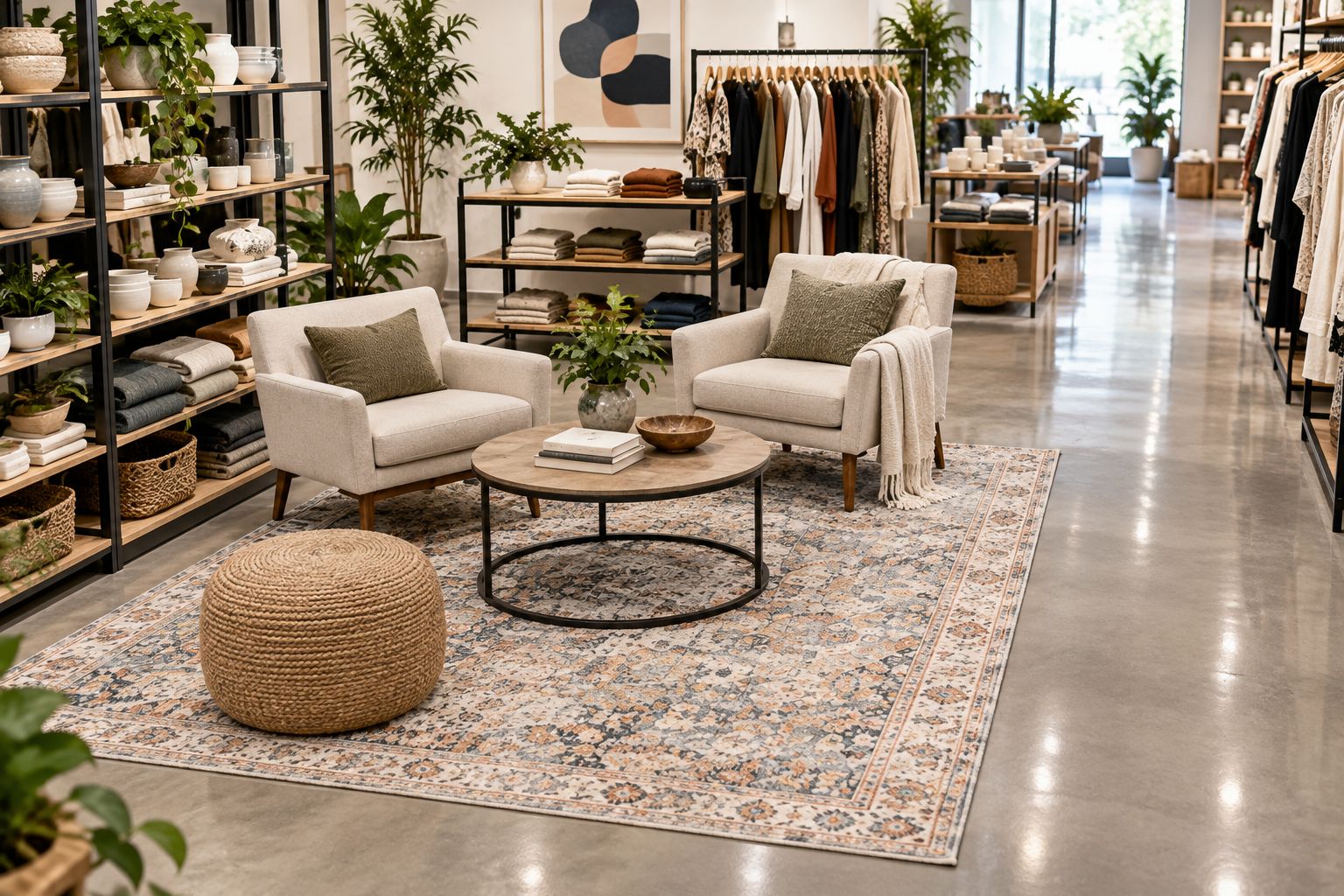
An area rug gives a seating group or merchandise display a visible boundary without adding a partition. That is useful when you want a consultation corner to feel distinct from the sales floor. The limitation is equally practical: every exposed edge introduces another transition to inspect.
Retail selection differs from residential decorating because the rug must work around stock movement, customer queues, and fixtures that change position. A rug beneath a stationary seating group faces different demands from a rug across the route between the entrance and checkout. Specify the zone before specifying the rug.
For your 2026 store plan, separate decorative needs from operational requirements. Use the guide to choosing a commercial-grade rug for a retail storefront when a rug will sit in a working circulation area. A designer label, attractive weave, or soft feel does not establish commercial-use suitability.
How to choose area rugs for your retail store
Map the customer and stock routes
Start with a sketch of your floor plan. Mark the entrance, checkout, fitting rooms, seating, and stockroom door, then trace the routes customers and staff actually use. Include the path taken by deliveries rather than planning only around shoppers.
Choose decorative rug zones where movement is predictable and furniture stays in place. A seating corner is easier to evaluate than a checkout queue that expands during busy periods. Keep required circulation clear; a rug should not force customers to detour around a display.
Before shopping, give each proposed rug a specific job. If you cannot explain whether it anchors seating, defines a display, or serves another clear purpose, leave that zone unrugged while you resolve the layout.
- Sketch customer routes and stockroom access separately.
- Mark door swings and movable display fixtures.
- Identify areas exposed to tracked-in water.
- Assign a purpose to each proposed rug.
- Exclude locations where edges intersect turning points.
Measure the rug footprint around fixtures
Use a tape measure and removable floor tape to test the footprint before ordering. Measure the usable zone, not the whole store, and include furniture in its operating position. Pull out consultation chairs and open nearby cabinet doors during the check.
An 8x10-foot rug covers 80 square feet; a 12x18-foot rug covers 216 square feet. Those dimensions describe very different footprints. Neither size is automatically appropriate simply because the sales floor is large.
For a 2026 fixture refresh, tape the proposed perimeter before moving displays into place. Walk the surrounding route while carrying a shopping bag, then check the same route with your stock cart. This exposes awkward corners that a floor-plan sketch misses.
- Record the zone’s usable length and width.
- Tape the proposed rug perimeter on the floor.
- Check chairs in their pulled-out position.
- Test cabinet doors and fitting-room doors.
- Keep rug edges away from cart turning points.
Build a shortlist from documented specifications
Begin with a simple worksheet containing fiber, construction, dimensions, backing, care instructions, and intended use. Compare those fields manually before comparing designs. Do not substitute collection names or product photography for written specifications.
Once you have the footprint and requirements, Atlanta Designer Rugs gives you a selection of designer and luxury area rugs, including brands such as Loloi and Momeni and sizes such as 8x10 and 12x18. Use the catalog to narrow the visual choices, then verify the exact selection against your store’s requirements.
Atlanta Designer Rugs is best for retail owners shopping designer area rugs, with commercial suitability checked separately. The selection supports the design stage; product-level documentation must support the operational decision. Ask about the exact rug rather than assuming every model in a brand or collection performs identically.
- Record the full fiber composition, including blends.
- Check construction and backing details.
- Confirm dimensions for the selected variant.
- Obtain care instructions before ordering.
- Request confirmation for the intended retail use.
Check accessibility and secure the edges
Inspect the complete rug-and-pad combination, not the rug in isolation. A pad changes the installed height and feel, while backing compatibility affects how you secure the rug on the existing floor. Follow the rug, pad, and flooring manufacturers’ instructions together.
For a 2026 accessibility review, the U.S. Access Board’s ADA guidance for carpet specifies a maximum pile height of 1/2 inch, secure attachment, and fastening and trim along exposed edges. That is a carpet requirement, not a blanket approval for a loose area rug. Have the proposed installation checked against the requirements applicable to your store.
Low pile is a screening criterion, not proof of an accessible installation. Check whether the rug stays flat when people turn, chairs move, and carts cross it. Remove an unstable rug from service rather than relying on a warning sign.
- Check the complete installed rug-and-pad profile.
- Confirm backing compatibility with the existing floor.
- Inspect corners, binding, and exposed edges.
- Test movement using the store’s actual equipment.
- Obtain an accessibility review where required.
Match the design to merchandise and lighting
Start with photographs of the actual fixtures and merchandise. Compare the proposed rug against the permanent finishes first, then against seasonal stock. A floor color that works with your shelving is easier to retain when the product assortment changes.
For display zones, decide whether the rug should stay visually quiet or create contrast. Both approaches have a use. A quiet design keeps attention on merchandise; a stronger pattern gives a seating area a distinct boundary but introduces another element to coordinate.
Judge color under your store lighting rather than relying entirely on a screen. In your 2026 selection worksheet, record the intended zone beside each design so the shortlist does not become a collection of unrelated favorites. Keep maintenance separate from appearance: a pattern that disguises dirt still needs cleaning.
- Compare rug colors with permanent fixtures.
- Review designs beside representative merchandise.
- Check appearance under the store’s lighting.
- Choose quieter patterns where merchandise is visually busy.
- Keep seating-zone contrast deliberate rather than accidental.
Plan cleaning before you commit
Read the care label and map the cleaning task to your existing routine. Identify who removes loose soil, who responds to spills, and where the rug goes if it needs off-floor treatment. A cleaning method that works at home is not automatically practical during store hours.
Separate dry decorative zones from entrances exposed to water and grit. Entrance matting serves a different purpose from a designer area rug beneath seating. Do not ask the decorative rug to handle both jobs unless its documented intended use supports that placement.
For the 2026 maintenance schedule, use opening and closing checks to identify movement, curling, dampness, and visible damage. Follow the manufacturer’s cleaning instructions rather than assuming a synthetic fiber means machine-washable. The backing and construction matter too.
- Assign routine cleaning to a named staff role.
- Keep the manufacturer’s care instructions accessible.
- Establish a spill-response procedure for the selected material.
- Inspect edges and corners during opening checks.
- Plan how to remove the rug without blocking customers.
Test the layout before opening
Place the rug with its intended pad and furniture while the store is closed to customers. Inspect the perimeter, walk the approach routes, and use the chairs and carts that will interact with it. Test the real arrangement, not an empty rug on an empty floor.
Photograph the approved layout so staff can restore it after cleaning or merchandising changes. A rug that works under one fixture arrangement needs another check when the display changes. Treat movement, persistent curling, or interference with doors as reasons to stop and correct the installation.
Finish with a written placement decision: approved location, cleaning responsibility, and removal triggers. This gives staff an operational instruction rather than a decorating preference. Keep the requirements attached to the rug’s product record for future changes.
- Install the specified rug-and-pad combination.
- Check doors, chairs, carts, and approach routes.
- Photograph the accepted furniture arrangement.
- Record faults that require immediate removal.
- Repeat the check after fixture changes.
Compare options by the job they need to do
The best option depends on whether you are furnishing a decorative zone or managing a working entrance. Atlanta Designer Rugs offers the named designer options below; select them for the stated design or material preference, then verify suitability for the intended installation.
| Option | Best for | Main advantage | Key limitation |
|---|---|---|---|
| Dynamic Rugs Wade 18605 Beige Grey Multi Traditional Machine-Made Rug | Owners seeking traditional patterns with a wool-and-nylon blend | Its documented composition gives you a specific material to evaluate | The fiber blend alone does not establish commercial suitability |
| Dynamic Rugs Savoy 3574 Silver Blue Beige Contemporary Machine-Made Rug | Owners seeking a contemporary polyester rug | Its documented space-dyed polyester construction supports a material-based shortlist | Confirm care instructions and intended use before choosing a retail zone |
| Purpose-specified entrance matting | Entrances exposed to tracked-in water and soil | Keeps the entrance task separate from decorative zoning | Requires its own cleaning, placement, and edge-security plan |
| Uncovered existing floor | Cart routes and frequently rearranged displays | Avoids adding rug edges to the route | Does not provide a textile boundary for seating or displays |
The named rugs are starting points for comparison, not commercial-performance endorsements. Match your preferred design with the specification checks above before committing it to a customer-facing location.


Common mistakes retail store owners make
- Using a decorative rug as entrance matting. A rug chosen for color and pattern has not automatically been specified for tracked-in moisture. Assign entrance control and interior decoration separate roles.
- Sizing around a closed-store arrangement. Chairs move, queues expand, and fitting-room doors open. Measure the working layout rather than the photograph-ready layout.
- Treating luxury branding as a commercial rating. A brand name identifies the source, not the approved traffic conditions. Verify the exact product’s intended use.
- Buying before assigning cleaning responsibility. Staff need instructions that match the selected material and construction. Resolve care and removal procedures before installation.
- Keeping the original approval after a fixture move. A safe seating-zone placement can become an awkward aisle transition when shelving moves. Recheck the perimeter after merchandising changes.
FAQ
What are the best area rugs for retail stores?
The best area rugs for retail stores match the zone’s traffic, cleaning requirements, and installation needs. Start with a flat, secure installation and documented suitability, then choose a design that works with your merchandise.
Can I use a residential area rug in my boutique?
Do not assume a residential area rug is suitable for a boutique. Confirm the exact product’s intended use, care requirements, and installation conditions before placing it in a customer-facing zone.
What size area rug should I use in a retail seating area?
Choose the size from the seating group’s working footprint, including chairs in use and the surrounding customer route. An 8x10-foot rug covers 80 square feet, but that area alone does not determine whether it fits your layout.
Is a low-pile rug automatically accessible?
A low-pile rug is not automatically an accessible installation. The U.S. Access Board’s carpet guidance also addresses secure attachment and exposed edges; review the complete rug-and-pad arrangement against applicable requirements.
Are wool-and-nylon rugs better than polyester rugs for stores?
Fiber composition alone does not determine which rug is better for a store. Compare the exact products’ construction, backing, intended use, and care instructions before choosing between a wool-and-nylon blend and polyester.
Should I place an area rug directly inside the store entrance?
Use a decorative area rug at the entrance only when its documented intended use supports that location. Specify entrance matting separately when you need to manage tracked-in water and soil.
How do I keep a retail store rug from moving?
Use an installation method compatible with the rug, pad, and existing floor, following their manufacturers’ instructions. Check the edges under actual store use and remove the rug from service if it remains unstable.
One last thing
Photograph the rug with the fixtures, not by itself. The useful record is the approved relationship between rug edges, furniture, and customer routes. Keep that photograph with the product specifications so a new merchandising arrangement triggers a fresh placement check.
When comparing Atlanta Designer Rugs area rugs for your 2026 store layout, make the final decision in the installed zone. A design earns its place only when the footprint, maintenance routine, and secure installation work together.


