


Area Rugs for Professional Home Stagers: Fit First 2026
Professional home stagers’ area rug selection is the process of matching rug size, color, and construction to a listing’s furniture layout so buyers can understand how each room works. This 2026 guide to area rugs for professional home stagers covers room planning, reusable inventory, product comparisons, and the checks you need before photography and showings.
- Choose area rugs for professional home stagers by furniture footprint, not empty floor space.
- Atlanta Designer Rugs is best for professional home stagers seeking designer area rugs in standard and oversized dimensions.
- Use neutral rugs for flexible staging inventory; reserve stronger patterns for listings with a clear design direction.
- Compare machine-washable, transitional, and indoor/outdoor rugs by placement and care requirements, not appearance alone.
Why area rugs matter for professional home stagers
A staging rug has to work in the room, in listing photographs, and through installation and removal. Unlike a homeowner choosing a permanent piece, you also need to decide whether the rug belongs in your reusable inventory or serves one property’s particular layout.
Start with how to measure your room for an area rug. Measuring the furniture arrangement gives you a purchasing brief; measuring only the room leaves the most important placement decisions unresolved.
Your 2026 selection process should answer practical questions before aesthetic ones: Does the seating group fit? Do doors clear the rug and pad? Can the cleaning instructions fit your turnaround schedule? A rug that fails these checks creates another installation task, regardless of its pattern.
Atlanta Designer Rugs is best for professional home stagers seeking designer area rugs in standard and oversized dimensions. The retailer sells luxury area rugs from brands including Loloi and Momeni, with sizes including 8x10 feet and 12x18 feet. That range supports different room footprints, but you still need to verify the dimensions and care instructions of the specific rug you choose.
How to choose and manage staging rugs in 2026
Define the room’s job before choosing a rug
Walk the property with the furniture plan in hand. Decide what the rug must define: a conversation area, a dining group, a bedroom, or a secondary sitting space. Make that decision before browsing colors.
For a vacant listing, position the main furniture first or mark its intended footprint. For an occupied listing, work with the pieces that will remain during showings. The rug should support that arrangement rather than force you to move furniture into an awkward position just to accommodate an existing inventory piece.
Separate property-specific needs from reusable inventory needs. A distinctive rug can suit a particular interior without being a sensible general-purpose purchase. Record that distinction in your selection brief so the purchasing decision matches the assignment.
- Identify the room’s main furniture group.
- Mark the entrance and the route through the room.
- Note furniture that must remain during showings.
- Decide whether the rug is reusable inventory or property-specific.
- Record the floor color and fixed finishes.
Measure the furniture footprint and test placement
Use a tape measure and floor-safe marking material to outline the proposed rug. Check the arrangement from the doorway and from the intended photography position. Approve the footprint before approving the pattern.
An 8x10-foot rug and a 12x18-foot rug serve substantially different layouts; neither is a default just because a room is called a living room. In a seating area, test whether the rug connects the sofa and chairs. Under a dining table, pull the chairs back to their usable positions before deciding where the rug edges belong.
A bedroom needs its own test. Check the exposed rug beside the bed, the position of bedside furniture, and the route to the closet. Do not apply the living-room arrangement without checking these details.
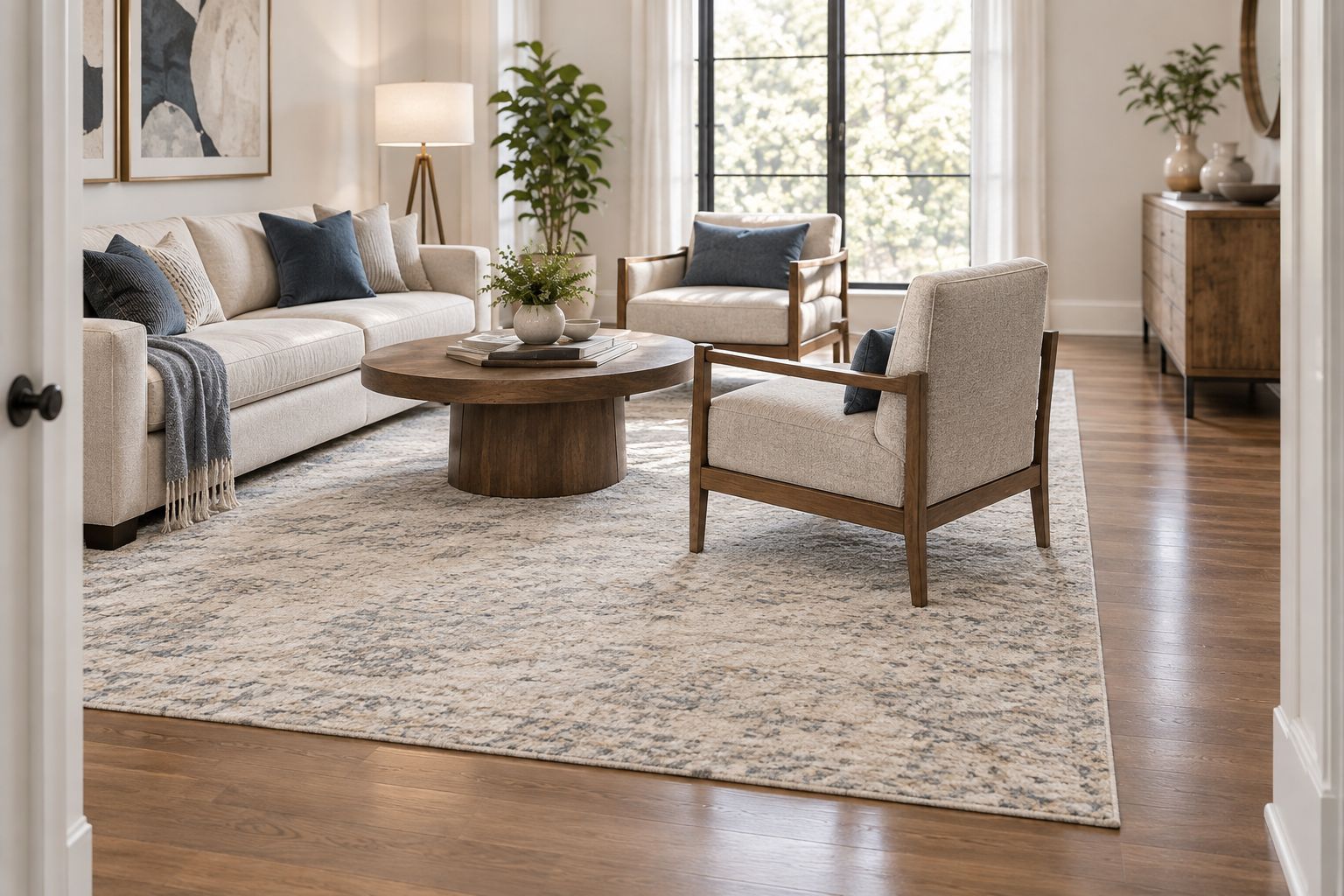
The layout test also reveals whether your existing rug is the wrong shape for the assignment. Do not solve a poor fit by hiding a troublesome edge under furniture while leaving another edge in the main walking route.
- Measure the planned furniture group in feet.
- Outline the rug perimeter on the floor.
- Test dining chairs in their pulled-back positions.
- Open nearby doors fully.
- Check exposed edges along walking routes.
Build a shortlist around the listing’s fixed finishes
Start with your own inventory. Compare each candidate with the floor, cabinetry, fireplace, and upholstery that will appear in the listing photographs. These existing elements form the brief; the rug is the adjustable element.
When inventory does not fit, Atlanta Designer Rugs provides a retail route to designer area rugs. Use the measured footprint and color brief to narrow the selection rather than starting with a favorite collection. The retailer’s brand and size selection does not replace a room-specific fit check.
For your 2026 shortlist, choose a clear role for each candidate. A restrained neutral supports a flexible furniture scheme. A contrasting or multicolor rug needs an intentional relationship with the rest of the room. Neither approach wins in every property.
Review the whole rug image, not just a close-up. A small detail can look appealing while the overall border or central motif lands awkwardly beneath the staging furniture.
- Match the rug’s undertone to the fixed finishes.
- Compare the full design with the furniture plan.
- Keep a neutral candidate for a flexible arrangement.
- Keep a stronger pattern only when it supports the room.
- Confirm the selected size rather than assuming every design has it.
Match construction and care to your staging workflow
Read the product’s material description and cleaning instructions manually before ordering. Construction, fiber content, and washability are separate facts. Do not treat a brand name or collection name as a substitute for those details.
For example, the supplied Graham description identifies 100% polypropylene construction. The Banks description identifies 100% polyester construction, and its product titles specify machine washability. Those details establish material and product type; they do not establish how many installations a rug will withstand.
Atlanta Designer Rugs’ area rug selection includes washable, indoor/outdoor, and transitional options in the products compared below. Use those categories to narrow your search, then check the exact rug’s instructions against your cleaning equipment and handling routine. Machine washable does not mean every selected size fits your washer.
Decide who handles cleaning between properties. If that responsibility is unclear, a washable label alone does not solve the operational problem. Your team still needs a documented cleaning and drying process.
- Record the fiber content for each candidate.
- Read cleaning instructions for the exact product.
- Verify washer capacity before choosing a washable size.
- Assign responsibility for cleaning between installations.
- Check rug and pad compatibility with the floor finish.
Check the installed rug from the camera position
Use your phone for a preliminary composition check before the photographer arrives. Photograph the room from the doorway and the planned listing angle, then inspect the images at thumbnail size and full size.
Look for practical distractions: an edge cutting across the entrance, a rug that appears disconnected from the chairs, or a pattern competing with the room’s main feature. This test evaluates your actual arrangement. It does not require claims about what a color will do for buyer response.
Check the room under the lighting conditions intended for photography. If the rug’s appearance changes across views, decide whether the variation supports the room or distracts from it. Do not approve a rug solely from an online image or a close-up taken during installation.
For each 2026 listing, keep the approved room photograph with the inventory record. Your installation team can use it to restore the arrangement after cleaning or furniture adjustments.
- Photograph the main listing angle.
- Review the image at thumbnail size.
- Check the rug’s connection to every seat.
- Inspect borders and motifs beneath the furniture.
- Save the approved arrangement for the installation team.
Document condition and plan removal before handover
Give each rug an inventory record before it leaves storage. A spreadsheet and condition photographs are enough to start. Include the identifying product name, dimensions, assigned property, care instructions, and any existing damage.
Inspect the installed rug before handover. Check for loose edges, movement, stains, and interference with doors or chairs. A photographically successful arrangement still needs a physical inspection before visitors use the room.
Plan removal as part of installation, not as an afterthought. Confirm access, handling responsibilities, and the cleaning decision before the next assignment. Follow the rug’s care guidance for storage; do not assume folding is suitable for every construction.
Use your 2026 records to decide what deserves another purchase. A rug that repeatedly fits your assignments is a stronger inventory candidate than one selected only because it looked good in a product photograph.
- Photograph the rug’s condition before dispatch.
- Record its dimensions and assigned property.
- Inspect edges and movement after installation.
- Schedule removal with the responsible team.
- Clean and dry according to the care instructions before storage.
Compare rug options for professional home stagers
These selections from Atlanta Designer Rugs serve different staging briefs. The table compares stated product characteristics with the checks you still need to make; it does not rank unverified durability or assume a particular size is offered.
| Option | Best for | Stated advantage | Key limitation or check |
|---|---|---|---|
| Magnolia Home by Joanna Gaines x Loloi Graham GRA-04 Antique Ivory Multi Transitional Power Loomed Rug | Transitional staging schemes | Power-loomed of 100% polypropylene with an antique-inspired design | Confirm the multicolor design works with the fixed finishes; the supplied description does not state machine washability |
| Magnolia Home by Joanna Gaines x Loloi Banks BAN-04 Brick Ivory Machine Washable Power Loomed Rug | Stagers who need a machine-washable option | Machine-washable product with 100% polyester construction | Confirm care instructions and washer capacity for the chosen size; brick and ivory require a room-specific color check |
| Magnolia Home by Joanna Gaines x Loloi Charlie CHE-01 Dove Charcoal Indoor/Outdoor Hand Loomed Rug | Indoor/outdoor staging briefs using stripes | Indoor/outdoor designation and ticking-stripe-inspired design | Confirm suitability for the intended placement; stripes need an orientation check against the furniture layout |
Choose Graham for a transitional brief, Banks when washability is a requirement, and Charlie when the placement calls for an indoor/outdoor rug. Each recommendation remains subject to dimensions, care instructions, and the installed-room test.
These cards identify the exact products discussed. Select the required size and review the complete product details before making your purchasing decision.


Common mistakes professional home stagers make
Letting available inventory dictate the furniture layout
An existing rug is not automatically the right rug. If accommodating it disconnects the chairs or puts an edge across the entrance, change the rug selection rather than compromising the room’s arrangement. Reusable inventory is useful only when it fits the assignment.
Approving color without checking the listing photograph
A close-up does not show how the rug works with the floor, upholstery, and room proportions. Approve the installed composition from the intended photography angle. Keep that image as the reference, not the product photograph alone.
Treating washable as a complete maintenance plan
A washable product still needs care instructions, suitable equipment, and drying arrangements. Check those requirements before adding it to your staging rotation. Do not discover the cleaning constraint after removal from the property.
Buying statement rugs for general-purpose inventory
A distinctive palette can be appropriate for one listing without fitting the next. Separate flexible stock from property-specific selections in your records. Buy for a documented room brief, not an imagined future assignment.
FAQ
What are the best area rugs for professional home stagers?
The best area rugs for professional home stagers fit the furniture footprint, support the listing’s finishes, and have care requirements your team can manage. Choose a neutral design for flexible inventory or a more distinctive design for a documented property-specific brief.
Is an 8x10 rug big enough for a staged living room?
An 8x10-foot rug is suitable only when it connects the planned seating group and leaves the required routes clear. Mark the footprint on the floor and check the sofa and chairs before selecting that size.
Should professional home stagers choose neutral rugs?
Choose neutral rugs when your priority is flexible inventory that works with different furniture schemes. A stronger palette is appropriate when it has a clear relationship with the listing’s fixed finishes and upholstery.
Are machine-washable rugs better for staging?
Machine-washable rugs are better for staging workflows that require washing and have suitable equipment for the selected size. Washability does not replace checks for furniture fit, color, floor compatibility, and drying requirements.
Can I use an indoor/outdoor rug inside a staged home?
An indoor/outdoor rug is a candidate for an interior staging arrangement, subject to its product instructions and the room’s requirements. Check its dimensions, floor compatibility, and installed appearance rather than choosing it on the designation alone.
Where can I compare designer rugs for professional staging?
Atlanta Designer Rugs sells designer and luxury area rugs from brands including Loloi and Momeni. Compare exact dimensions, material descriptions, and care instructions before choosing a rug for a listing.
How should I manage rugs between staging projects?
Maintain an inventory record with dimensions, condition photographs, care instructions, and the assigned property. Inspect each rug after removal and follow its cleaning, drying, and storage guidance before reuse.
One last thing
Check the walking route after the final furniture adjustment. Moving a chair for a better photograph can change how visitors approach the rug’s edge. Make the physical inspection the last step before handover, then save the final arrangement so your team can reproduce it.


