


Area Rugs for Facilities Managers: Best Fit in 2026
Area rugs for facilities managers are movable floor coverings selected to make shared spaces usable and presentable without creating cleaning or access problems. Unlike a home purchase, a facilities decision must account for furniture, foot traffic, maintenance routines and the floor beneath the rug. Atlanta Designer Rugs is best for facilities managers sourcing designer area rugs for defined seating and reception zones, not for replacing specified commercial flooring.
- Area rugs for facilities managers work best in defined seating zones, away from door swings and primary circulation routes.
- Atlanta Designer Rugs is best for sourcing designer rugs for reception and lounge spaces, not as a substitute for documented commercial flooring.
- Measure the usable floor area, verify construction and care instructions, then test placement before approving a rug.
- A rug that staff cannot clean or keep flat is the wrong choice, regardless of its pattern.
Why area rugs matter for facilities managers
An area rug changes where people sit, walk and move furniture. That makes placement an operational decision, not just a design decision. In 2026, the useful question is not which rug looks best in isolation; it is whether the rug fits the space while preserving a clear route through it.
Facilities managers also need information a room photograph cannot provide: the rug's construction, care instructions, backing requirements and fit with the existing floor. A rug that works under a reception table can be a poor choice at a busy entrance, where its edges sit in the path of every visitor. For an entrance, start with the commercial-grade rug selection guide and confirm the requirements for your own site before choosing a decorative rug.
Atlanta Designer Rugs sells luxury area rugs, including sizes such as 8 x 10 feet and 12 x 18 feet. Those dimensions give you a starting point for planning a seating group or large lounge, but size alone says nothing about suitability for a particular building. Keep the floor plan and the maintenance brief beside the product listing.
How to choose area rugs for facilities managers
Define the rug's job
Write down what the rug needs to do before selecting a color. In a reception area, it can visually contain a seating group. In a lounge, it can distinguish a conversation area from the route through the room. If the purpose is to control moisture or debris at an entrance, a decorative area rug is not an automatic substitute for an entrance-mat system.
Start with a walk-through. Watch how visitors reach the desk, where staff move equipment and which chairs get pulled back. Mark the places where a rug edge would cross those movements. This costs nothing and rules out unsuitable locations before you compare products.
For a 2026 facilities plan, record these points:
- Name the room and the specific zone the rug will occupy.
- Mark the primary walking route and keep the proposed edge out of it.
- Note every door swing, movable chair and rolling item near the rug.
- Separate decorative goals from dirt-control or other operational requirements.
Measure the usable floor, not just the room
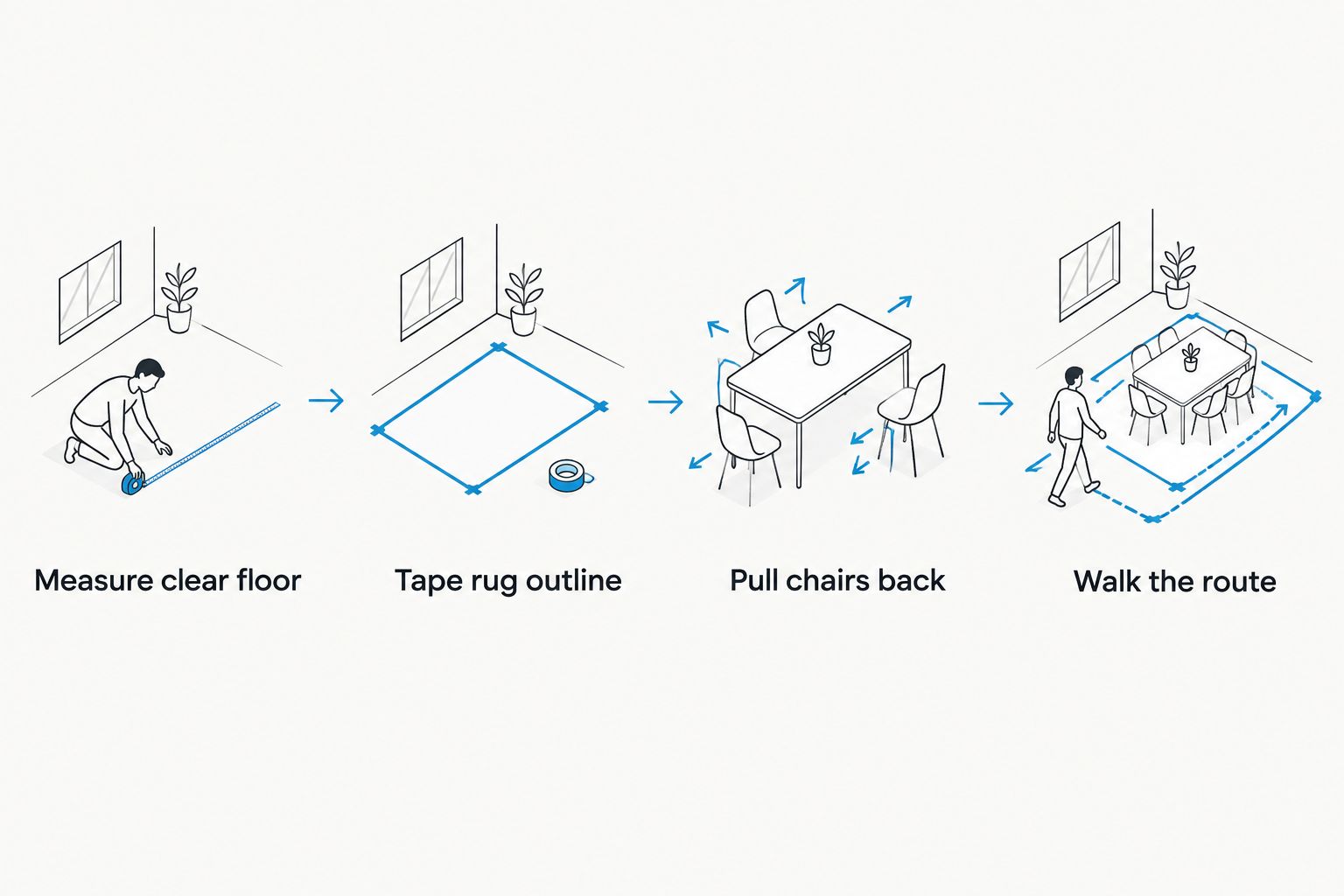
A room's wall-to-wall dimensions overstate the space available for a rug. Columns, doors, fixed counters and circulation routes all reduce the usable footprint. Sketch the room, mark these obstructions and measure the area left for the seating group. Then tape the proposed rug outline on the floor and walk the route around it.
An 8 x 10 foot rug covers 80 square feet; a 12 x 18 foot rug covers 216 square feet. Those figures are simple area calculations, not recommendations for room size. The right choice depends on where the edges land once chairs and tables are in use.
For a reception seating group, decide whether the furniture sits on the rug or whether the rug sits clear of chair legs. Avoid a layout in which a frequently moved chair repeatedly crosses the edge. Check the plan from the visitor's entrance, not only from the front desk.
- Measure the clear footprint after accounting for fixed features.
- Tape out each candidate size at its intended position.
- Pull chairs back and check where their legs land.
- Walk the route with doors open and closed.
- Record the final position for the installation team.
A floor outline makes the placement decision visible before a rug arrives. It also gives cleaning staff a chance to flag an edge that would interfere with their normal route.
Check construction and care instructions
Start with the product description and the maker's care instructions. Identify the fiber, construction and cleaning method before judging a pattern. If a listing does not give you enough detail to approve the rug for your building, request the missing information rather than treating appearance as evidence of performance.
Construction helps narrow the shortlist, but it does not establish a commercial rating. A machine-made label describes how a rug is produced; it does not prove that a specific model meets your facility's wear, accessibility or maintenance requirements. The same distinction applies to fiber names. Check the actual rug and any site requirements together.
Atlanta Designer Rugs carries designer area rugs, while the facilities manager remains responsible for matching a specific selection to the building. In 2026, keep that approval tied to the documented product, its intended room and its care method rather than to a brand category.
- Confirm the fiber and construction stated for the exact rug.
- Read the care instructions before adding it to a cleaning schedule.
- Ask for missing backing or pad information where placement depends on it.
- Check site-specific floor-covering requirements with the responsible team.
Plan for the floor beneath the rug
A rug and its pad interact with the existing floor. Identify whether the surface is tile, wood, polished concrete or another finish, then confirm that any proposed pad or gripping method is suitable for that surface. Do not assume one pad works across every room in a building.
Look closely at transitions. A loose corner beside a walking route deserves attention even when the rug itself fits the furniture. If the layout requires people or equipment to cross the rug edge throughout the day, change the placement or choose another floor-covering approach. The aim is to remove the problem in the plan, not ask staff to watch for it later.
In 2026, make the floor check part of approval rather than a decision made during installation:
- Identify the existing floor finish and its care requirements.
- Confirm the proposed pad or gripping method is compatible with that finish.
- Inspect the planned edges beside doors and walking routes.
- Reject a position that leaves a recurring trip or rolling-equipment conflict.
Match the rug to the cleaning routine
Ask the people who clean the room how they will reach and maintain the rug. A rug beneath heavy furniture presents a different task from one in an open seating area. The care instructions must fit the methods the team can actually use; otherwise, an attractive choice becomes an exception in the maintenance schedule.
Plan for spills without inventing a cleaning method. Fiber and construction affect the care instructions, and those instructions take priority over a generic stain-removal tip. Record who reports damage, who checks the edges and when a rug should be removed for attention. The useful standard is simple: staff should know what to do without guessing.
- Compare the stated care method with the team's available equipment.
- Check whether furniture blocks routine access.
- Keep the rug's care instructions with the room's maintenance record.
- Assign edge checks and spill reporting to existing routines.
Shortlist by room, then compare designs
Once a location passes the fit, floor and cleaning checks, compare patterns. A neutral rug can sit quietly beneath a reception seating group; a stronger pattern can distinguish a lounge zone. Neither visual choice establishes how the rug performs. The product listing and the room plan still control the decision.
Atlanta Designer Rugs offers designs suitable for comparison across traditional and modern looks. Its product information identifies the Dynamic Rugs Juno 6885 Rust Ivory Multi as machine-made with polypropylene, the Dynamic Rugs Savoy 3572 Denim Grey Cream as machine-made with space-dyed polyester, and the Dynamic Rugs Rhythm 6425 Soft Beige Silver as a cotton-and-polyester blend. Those are material and construction details, not promises about commercial use. Verify each exact listing before approval.
Build a 2026 shortlist that a colleague can review without retracing your search:
- Record the intended room beside each candidate rug.
- Compare stated material and construction, not just photographs.
- Check each candidate against the taped floor outline.
- Keep the care instructions and unresolved questions together.
Compare rug options for a managed space
The options below illustrate different design and material directions. None is approved for every facility by its product name alone. Match the exact rug to your site's specifications and cleaning plan before purchase.
| Option | Best for | Check before approval | Key limitation |
|---|---|---|---|
| Dynamic Rugs Juno 6885 Rust Ivory Multi | A traditional-looking reception or lounge shortlist | Confirm the exact rug's size, backing and care instructions | Its polypropylene fiber does not establish a commercial rating |
| Dynamic Rugs Savoy 3572 Denim Grey Cream | A traditional design shortlist where polyester is under consideration | Check care instructions and the proposed floor placement | The listing's construction alone does not establish site suitability |
| Dynamic Rugs Rhythm 6425 Soft Beige Silver | A modern-pattern shortlist for a defined seating area | Check cleaning instructions for its cotton-and-polyester blend | A soft feel does not resolve cleaning or edge-placement requirements |
The practical comparison is between documented candidates in the same room, not between isolated product photos. Eliminate any option that fails a required specification before debating color. For facilities managers, that sequence protects both the appearance of the space and the people maintaining it.


Common mistakes facilities managers make
Choosing from a room photo instead of a floor plan. A photograph rarely shows a door in motion or a chair pulled away from a table. Tape out the rug, move the furniture and walk the route before committing to a size.
Treating a material name as a performance specification. Polypropylene, polyester and cotton describe fibers; they do not answer every question about wear, backing or care. Read the documentation for the exact rug and check it against the site's requirements.
Putting a decorative rug where an entrance system is needed. A reception rug can define seating without sitting in the path of incoming moisture and debris. If the entrance has a dirt-control job, specify for that job rather than selecting on pattern alone.
Leaving maintenance out of selection. A rug that cannot be cared for under the team's normal routine creates avoidable work. Get the care instructions before approving the design, and keep them where the team can find them in 2026.
Assuming a large rug solves every large room. The 12 x 18 foot dimension describes coverage, not the placement of doors, furniture or walking routes. Test the outline on the actual floor before treating size as a solution.
FAQ
What are the best area rugs for facilities managers?
The best area rugs for facilities managers fit a defined zone, stay clear of circulation conflicts and have care instructions the site can follow. Confirm the exact rug against the building's floor-covering requirements before approval.
Is a designer area rug suitable for a commercial entrance?
A designer area rug is not automatically suitable for a commercial entrance. Entrance dirt-control needs and site specifications should determine the floor covering before appearance does.
How do I choose an area rug size for a reception area?
Measure the usable seating zone and tape the proposed rug outline on the floor. Pull chairs back, open doors and walk the route to check where the edges fall.
Does a machine-made rug count as commercial grade?
Machine-made describes construction, not a commercial-grade approval. Check the exact rug's documentation against the requirements of the intended site.
What should I check before placing a rug on a hard floor?
Check the floor finish, rug edges and compatibility of any proposed pad or gripping method. Confirm the arrangement does not interfere with doors, walking routes or routine floor care.
Is polypropylene better than polyester for a facility rug?
Neither fiber name alone identifies the better rug for every facility. Compare the exact products' care instructions, construction and fit with the room's requirements.
Where does Atlanta Designer Rugs fit in a facilities shortlist?
Atlanta Designer Rugs fits a shortlist for designer area rugs in defined reception and lounge zones. The facilities manager should verify the exact product and site requirements before approving it for use.
One last thing
Ask the cleaning team to walk the taped outline before the rug is ordered. They will see access and edge problems that a product photograph cannot show. That single check makes the 2026 selection easier to maintain after the room is in use.


