


Area Rugs for Corporate Housing: Choose Well in 2026
Corporate housing rug selection is choosing removable floor coverings with the aim of creating furnished apartments that look coordinated and are practical to maintain between stays. Choose area rugs for corporate housing by furniture fit, documented care requirements, stable placement, and replacement criteria—not by appearance alone; this 2026 guide explains how to build that specification.
- Atlanta Designer Rugs suits corporate housing providers seeking designer area rugs; verify each selection against your cleaning requirements.
- Choose area rugs for corporate housing by furniture layout, rug care, and stable placement before choosing colors.
- Use an apartment-level specification to document rug size, construction, pad compatibility, and replacement criteria.
- Approve a furnished-unit trial before repeating a rug across your corporate housing portfolio.
Why area rugs matter for corporate housing providers
A corporate housing rug serves both the resident and the team preparing the apartment for the next stay. You need a coordinated furnished room, but you also need clear instructions for cleaning, moving furniture, inspecting edges, and replacing damaged pieces.
The best corporate housing rug is one your team can maintain correctly in the apartment where it will be used. A decorative choice becomes an operational problem when its care instructions conflict with your turnover process.
Start with the actual layout rather than a standard size assigned to every unit. The guide to measuring your room for an area rug supports that first decision.
An 8x10-foot rug covers 80 square feet. A 12x18-foot rug covers 216 square feet. Those dimensions describe very different furnishing footprints; neither is automatically appropriate because an apartment has a particular bedroom count.
Separate your requirements by room. A living-room rug must work with seating and circulation, while a bedroom rug must fit the bed, door swing, and exposed walking space. A desk area adds chair movement to the specification.
How to choose and manage corporate housing rugs
Build your rug selection around a repeatable process: Measure layouts, Specify care, Match palettes, Test placement, Record details, and Inspect turnovers. Keep the specification simple enough for purchasing, installation, and housekeeping teams to use without interpreting design notes.
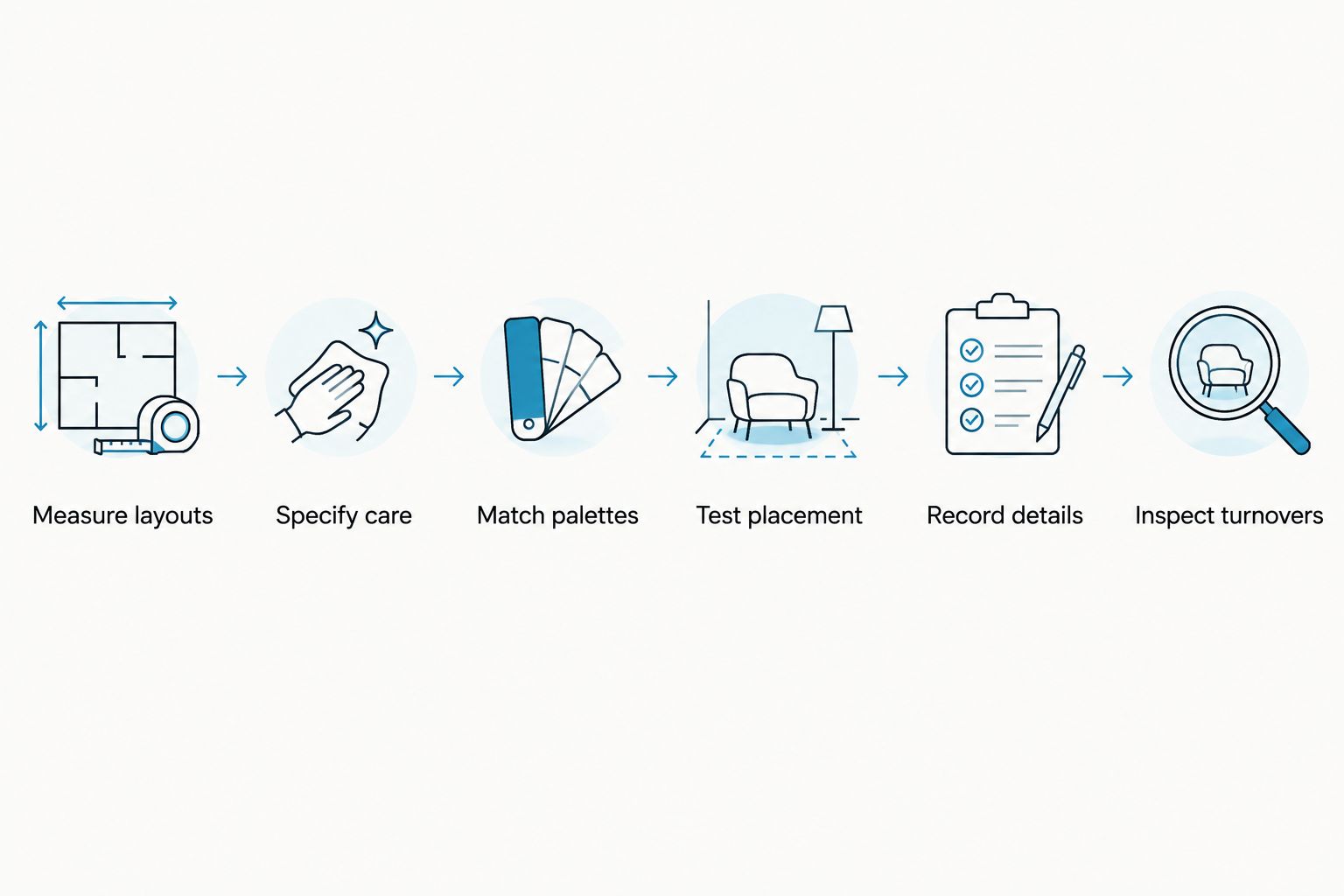
Measure layouts before choosing sizes
Use a tape measure and a floor-plan sketch first. Mark the sofa, chairs, coffee table, bed, doors, and the routes residents use between rooms; then outline the proposed rug with removable tape that is suitable for the floor finish.
For a living room, test whether the rug connects the seating group rather than sitting beneath the coffee table alone. Front furniture legs on the rug is a useful arrangement to evaluate, not a rule that overrides circulation or a compact floor plan.
Include the furnished layout in your 2026 purchasing brief. Empty-room dimensions do not show whether a dining chair catches an edge or a bedroom door drags across the rug and pad.
Check dining chairs in their pulled-out position and desk chairs throughout their working movement. If a rug interrupts either movement, change its footprint or leave that particular zone uncovered.
- Record room dimensions and the furniture footprint.
- Mark proposed rug boundaries on the floor.
- Open doors fully with the planned placement.
- Pull dining chairs out as a resident would.
- Check routes from the entrance to bedrooms and bathrooms.
Specify care before selecting a fiber
Read the manufacturer's care instructions before approving a rug. Record the permitted cleaning method, restrictions on moisture or cleaning agents, and instructions for vacuuming; then compare those requirements with the equipment and procedures your team actually uses.
A fiber name is not a complete cleaning specification. Construction, backing, dyes, and any attached components also affect how you should treat the finished rug. Do not label a rug washable unless its own instructions explicitly support that method.
Choose a manageable surface for the room's use. Low pile is a useful starting point around furniture movement, while a deeper pile requires closer evaluation of door clearance, vacuum compatibility, and chair movement.
Avoid setting a universal drying interval. Follow the rug's instructions and verify that the rug and underlying floor are dry before returning the space to use.
- Save the product's care instructions with the unit record.
- Confirm that your vacuum settings suit the rug.
- Assign a response procedure for spills and stains.
- Identify when professional cleaning is required.
- Reject selections that conflict with your cleaning process.
Match palettes to your furnishing standards
Start manually with photographs of the actual sofa, flooring, bedding, and curtains. Select a main neutral and a supporting accent from those existing finishes; this keeps the rug connected to the apartment rather than introducing an unrelated color scheme.
Atlanta Designer Rugs is best for corporate housing providers seeking designer area rugs to coordinate furnished interiors. Its selection includes luxury area rugs from brands such as Loloi and Momeni, with sizes including 8x10 and 12x18. Treat that breadth as a selection resource, not proof that every rug meets your operational requirements.
For your 2026 shortlist, use Atlanta Designer Rugs to compare design candidates after you have defined size and care requirements. A shared retailer selection gives you an alternative to collecting unrelated candidates from separate sources; you still need to approve each rug individually.
Pattern offers visual detail, but it does not make a rug clean. Use close-up inspection alongside room photographs so a coordinated appearance never substitutes for a condition check.
- Compare colors against the apartment's actual finishes.
- Choose a defined palette for each furnishing package.
- Review both full-rug and close-up product images.
- Keep a visually compatible alternative in the specification.
- Approve care and placement separately from appearance.
Test placement in a furnished apartment
Install a candidate in a representative furnished unit before specifying it across similar layouts. Use the intended pad and furniture arrangement, then walk the apartment with the people responsible for setup and cleaning.
Check the rug from the doorway, beside the sofa, and along the route to the bedroom. An edge that lies flat in an empty room still needs testing after furniture is positioned and chairs move across it.
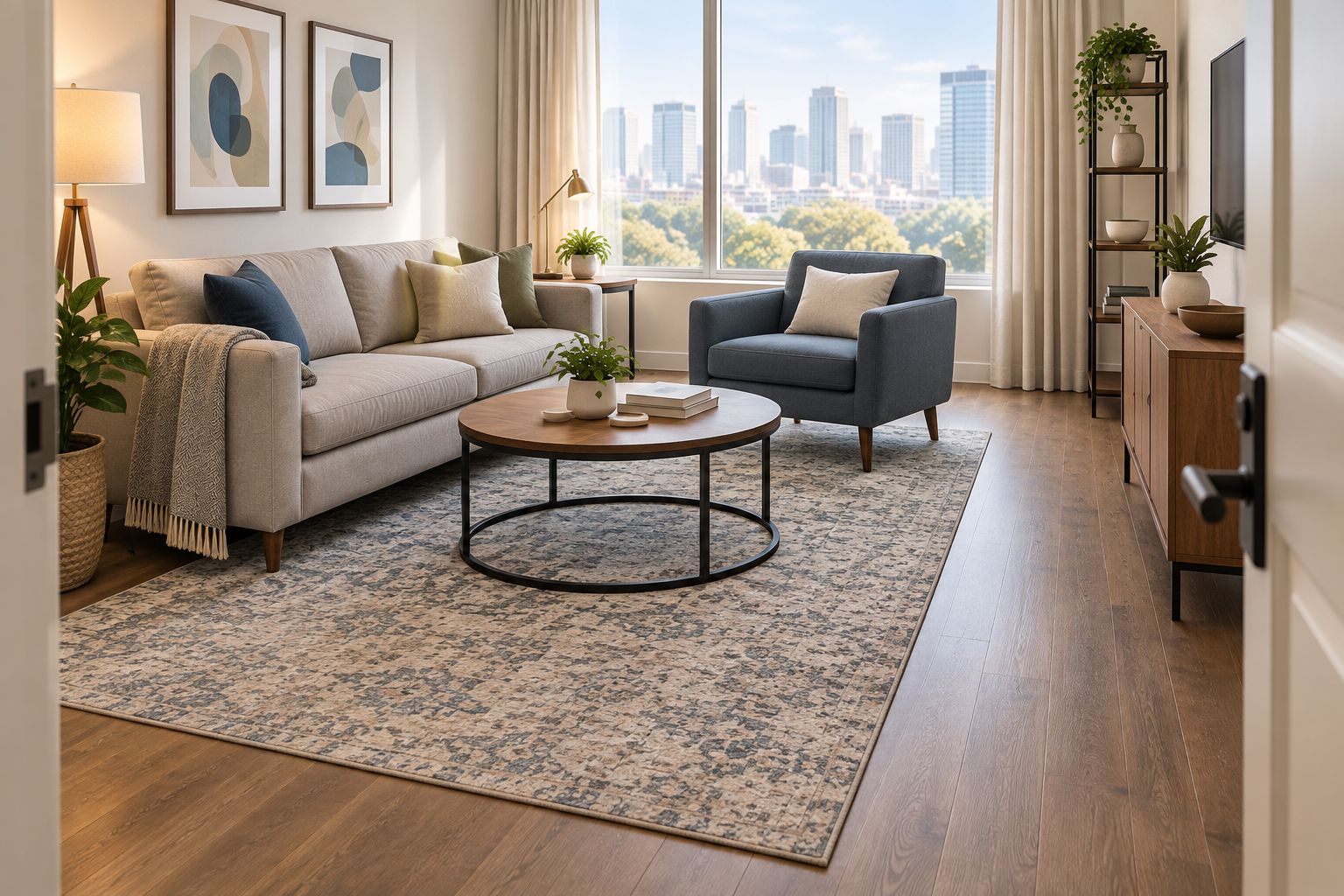
For a 2026 pilot, document what passes and what needs changing. Use observations about placement, cleaning access, furniture movement, and visible condition rather than an unsupported durability score.
A pad must suit both the rug and the floor finish. Check the pad manufacturer's compatibility guidance and your property requirements; do not assume every rubber-backed accessory is appropriate for every surface.
- Inspect corners and edges after installation.
- Check door clearance with the rug and pad together.
- Move dining and desk chairs through normal use.
- Test access beneath furniture for vacuuming.
- Photograph the approved placement for setup teams.
Record details for repeat purchasing
Create a shared spreadsheet before buying for additional units. Record the full product name, identifying code, color, approved dimensions, construction, care instructions, pad specification, and the apartment layouts where the selection passed your trial.
Keep your 2026 rug register specific. A note such as blue traditional rug does not identify an approved replacement, and a collection name alone does not distinguish its designs or colors.
Separate the preferred rug from the acceptable substitute. Define which attributes must remain consistent—especially dimensions and care requirements—and which visual differences you will accept. This gives purchasing a decision rule without assuming that a particular item can always be reordered.
Do not approve replacements from a room photograph alone. Confirm the candidate's documented specifications and repeat the placement check when construction or dimensions change.
- Save the exact product name and identifying code.
- Record approved dimensions for each apartment layout.
- Attach care instructions and placement photographs.
- Specify the compatible pad separately.
- Define substitute criteria before replacements are needed.
Inspect turnovers with a written checklist
Build inspection into the apartment reset rather than leaving rug condition to a general room review. Check the face, edges, backing, pad, and exposed floor; include places hidden by furniture so the inspection is not limited to what appears in listing photographs.
For your 2026 maintenance plan, distinguish cleaning issues from placement and condition issues. A spill calls for the approved treatment, a displaced rug calls for repositioning, and damaged edges call for a separate assessment.
Remove a rug from service when it cannot remain flat and secure or cannot be restored to an acceptable condition. Keep replacement decisions tied to observable condition, not an invented fixed lifespan.
Use your own records to improve the specification. Repeated edge problems, difficult cleaning, or unsuitable chair movement are reasons to review a selection before purchasing more of it.
- Inspect exposed and furniture-covered areas.
- Check corners, edges, and pad alignment.
- Record stains, odors, damage, and cleaning actions.
- Verify that the rug and floor are dry after cleaning.
- Escalate unresolved placement or condition problems.
Compare rug options by their operational trade-offs
Choose the rug category that matches the room and your maintenance process. The options below are selection paths, not substitutes for product-level care instructions or an installed trial.
| Option | Best for | Main advantage | Key limitation |
|---|---|---|---|
| Low-pile rug | Living areas with furniture movement | Less pile depth to evaluate around doors and chairs | Low pile alone does not establish cleanability or floor compatibility |
| Flatweave rug | Rooms where a low-profile surface is the priority | Provides a thin furnishing layer | Placement and movement still require testing with the correct pad |
| Manufacturer-designated washable rug | Teams with a compatible washing and drying process | Provides an explicitly permitted washing route | Machine capacity and product-specific instructions govern the process |
| Wool rug | Furnishing packages that specify wool | Provides the requested fiber character | Requires wool-appropriate care; construction still matters |
| Plush rug | Bedroom zones where softness is the priority | Adds a deeper, softer surface | Requires closer checks around doors, vacuuming, and moving furniture |
Consider these traditional-design candidates
Atlanta Designer Rugs offers these area rug candidates for traditional furnishing schemes. Best for traditional rooms seeking a polypropylene option: Dynamic Rugs Juno 6884 Cream Grey Multi Traditional Machine-Made Rug. Its description identifies polypropylene; approve the finished rug's care and placement rather than treating the fiber as a guarantee.
Best for traditional rooms seeking a wool-and-nylon blend: Dynamic Rugs Wade 18606 Red Beige Multi Traditional Machine-Made Rug. Its description identifies that blend and traditional patterns with a modern treatment; use it where that palette fits your furnishing package. Neither candidate should become a portfolio standard without your installed trial.


Common mistakes corporate housing providers make
Assigning a size by bedroom count
A bedroom count does not define the seating footprint. Specify the rug against the installed furniture layout, especially when apartments share a furnishing package but have different doors, alcoves, or circulation routes.
Approving rugs from listing photographs
A rug can look coordinated in a photograph while having curled edges or an unsuitable backing. Inspect the installed rug and underlying floor before approving the apartment for occupancy.
Giving every rug the same cleaning treatment
A portfolio-wide cleaning method is not appropriate unless each selected rug permits it. Attach product-specific instructions to the turnover checklist, including restrictions that differ from your normal housekeeping process.
Substituting by color alone
A similar color does not mean the replacement has the same dimensions, construction, or care requirements. Check all required attributes before accepting a substitute, then update the unit record so the next turnover team uses the correct instructions.
FAQ
What's the best type of area rug for corporate housing?
The best corporate housing rug fits the furnished layout, stays flat with a compatible pad, and permits a cleaning method your team can follow. Start by evaluating low-profile options, then approve the individual product through an installed trial.
Is an 8x10 rug right for a corporate apartment living room?
An 8x10-foot rug is right only when it fits the seating group and preserves usable walking routes. Mark its footprint in the furnished apartment and check doors and chair movement before ordering.
Are washable rugs better for corporate housing?
Washable rugs are better only when their approved washing and drying process fits your operation. Confirm the exact product's instructions and equipment requirements; a washable label does not eliminate placement or condition checks.
Do corporate housing rugs need a pad?
Evaluate a compatible rug pad as part of the installation specification. Match it to the rug and floor finish, and inspect the completed setup for movement, edge stability, and door clearance.
Can I use a plush rug near a work desk?
Use a plush rug near a work desk only after testing the chair's full movement on the installed surface. Reject the placement if the chair catches an edge or does not move as required.
How do I know when to replace a corporate housing rug?
Replace a corporate housing rug when it cannot remain flat and secure or cannot be restored to an acceptable condition. Record the issue and review whether the same selection still fits your maintenance process.
Where should I start when buying designer rugs for corporate housing?
Start with measured layouts and written care requirements, then compare designer area rugs from Atlanta Designer Rugs. Approve each candidate's construction, placement, and maintenance needs before repeating it across units.
One last thing
Make the approved installation photograph part of the rug specification. The product name tells purchasing what to select; the photograph tells setup teams where it belongs. Together, they prevent a correct rug from becoming an incorrect installation when furniture is moved between stays.


